

Buying online is changing again. Not because websites suddenly look different, but because AI agents are starting to take a more active role in how people research, compare, decide, and purchase. For businesses, that creates a real shift in digital commerce strategy. Agentic commerce is no longer a fringe concept tied to future hype. It is becoming a practical consideration for brands that want to stay visible, competitive, and easy to buy from. This page explains what agentic commerce means, where it fits, what risks to watch, and how businesses can prepare with the right data, systems, and automation foundations.
What Agentic Commerce Means And Why It Matters Now
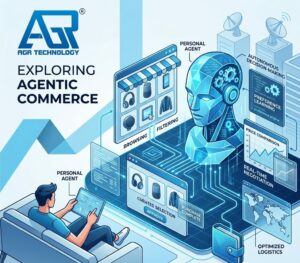
Agentic commerce refers to commerce experiences where autonomous or semi-autonomous AI agents help complete tasks across the buying and selling process. That can include product discovery, comparison, recommendations, checkout support, reorder decisions, procurement workflows, and post-purchase actions.
Unlike a basic chatbot or rules-based eCommerce automation, an AI agent can evaluate context, interpret goals, and take multi-step actions with less manual input. In plain terms, instead of only answering questions, it can help get the job done.
Why does that matter now?
- Consumers increasingly expect faster, lower-friction digital experiences
- Businesses are under pressure to reduce service costs while improving conversion
- AI models, APIs, and workflow tools have become more accessible
- Large platforms are training users to interact with conversational and task-based AI
For small and enterprise businesses alike, this creates both an opportunity and a visibility challenge. If customers begin relying on AI shopping assistants or procurement agents, brands need their product data, service information, and digital systems structured in a way those agents can understand and act on.
How Agentic Commerce Works Across The Customer Journey
Agentic commerce can influence nearly every stage of the customer journey, from early research through to retention.
At the awareness stage, AI agents may surface relevant providers, products, or services based on a user’s goals rather than a simple keyword search. During consideration, they can compare options, review pricing, assess features, and filter recommendations based on constraints like budget, delivery windows, compliance, or integration needs.
At the decision stage, an autonomous agent might:
- answer objections in real time
- personalize bundles or pricing paths
- initiate checkout steps
- schedule consultations
- trigger internal approvals for B2B purchases
After purchase, the same system can support onboarding, reorder cycles, account support, and upsell opportunities based on usage patterns.
This is especially relevant in service-led sectors. A business evaluating software, SEO, AI automation, or digital transformation support may not want to fill out long forms, wait for callbacks, and repeat the same questions. An effective agentic commerce setup can shorten that path.
For businesses working with a digital partner like AGR Technology, this opens the door to smarter customer journeys supported by AI automation, custom development, CRM integration, and better data flow across systems.
The Difference Between Traditional Ecommerce AI And Autonomous Agents
Traditional eCommerce AI usually improves one task at a time. Think product recommendations, dynamic pricing, search autocomplete, fraud detection, or email automation. These tools are useful, but they tend to operate inside narrow rules or predefined outputs.
Autonomous agents are different because they can combine reasoning, memory, decision logic, and action across multiple steps.
A simple comparison helps:
- Traditional eCommerce AI: recommends a product based on past browsing
- Autonomous agent: identifies a need, compares suitable products, checks stock, applies business rules, and completes or assists with purchase actions
That does not mean every business needs a fully autonomous system. In many cases, the best starting point is a controlled agent that supports staff or customers within clear guardrails.
This distinction matters commercially. Businesses should not assume that adding a chatbot equals agentic commerce readiness. Real agentic capability often depends on structured product or service data, system integrations, permissions, workflow logic, and human oversight.
In other words, the interface is only the visible layer. The real value sits behind it in the architecture.
Where Businesses Can Apply Agentic Commerce First
Most businesses should not start with a broad, fully autonomous rollout. The better approach is to identify high-friction, high-value workflows where AI agents can assist safely and measurably.
Strong early use cases include:
- Lead qualification: agents collect requirements, route inquiries, and book sales calls
- Product or service matching: customers receive guided recommendations based on needs
- Quote generation: agents gather inputs and prepare pricing ranges or scope summaries
- Customer support automation: common account, order, and service questions are handled faster
- Procurement and reordering: repeat purchases can be suggested or initiated automatically
- Internal sales assistance: staff use AI agents to surface product, stock, pricing, or customer data
For B2B organizations, agentic commerce is often less about flashy front-end shopping and more about reducing delays in complex decision-making. For B2C brands, it may improve conversion rates by removing buying friction.
AGR Technology can support this through custom software, AI workflow design, website integration, and digital strategy, helping businesses prioritize practical use cases instead of chasing trends. That matters, because the fastest wins usually come from fixing one expensive bottleneck at a time.
Benefits, Risks, And Governance Considerations
The upside of agentic commerce is significant, but so are the governance demands.
Potential benefits include:
- faster decision support for buyers
- lower operational load on service and sales teams
- more personalized commerce experiences
- better conversion pathways
- improved scalability without adding equal headcount
But there are real risks.
Autonomous systems can make poor recommendations if the source data is inaccurate or incomplete. They can also create compliance issues if they expose pricing incorrectly, mishandle personal information, or act outside approved business rules. In regulated industries, these risks are even more serious.
Key governance considerations include:
- clear approval thresholds for actions
- human review points for sensitive decisions
- audit trails and logging
- access controls and data permissions
- testing for bias, accuracy, and failure handling
Trust will be a deciding factor in adoption. Businesses need AI systems that are not only capable, but accountable. That means documentation, policy alignment, and technical safeguards need to be built in from the start, not patched on later.
How To Prepare Your Business For Agentic Commerce
Preparing for agentic commerce starts well before a business launches an AI agent. The groundwork is mostly operational.
A sensible preparation plan includes:
- Audit customer journeys to find delays, drop-off points, and repetitive manual tasks
- Clean up data sources so product, pricing, inventory, service, and policy information is accurate
- Connect core systems such as CRM, eCommerce, ERP, booking, and support platforms
- Define guardrails for what an agent can recommend, approve, trigger, or complete
- Start with one use case and measure performance before scaling
- Maintain human oversight for complex, high-risk, or high-value actions
This is where many organizations need a technical and strategic partner. Agentic commerce is not just a content exercise or a front-end feature. It touches digital infrastructure, customer experience, automation logic, security, and analytics.
AGR Technology helps businesses build the foundations through AI automation, custom software development, digital optimization, and integrated online systems. For organizations exploring what comes next in eCommerce, lead generation, or service delivery, that creates a practical path from concept to implementation.
Businesses that prepare early will be in a stronger position as AI-mediated buying behavior becomes more common.
Conclusion
Agentic commerce is changing how businesses get discovered, compared, and chosen. The shift is not only about AI tools. It is about building systems that make buying easier and smarter. Businesses that invest now in clean data, strong workflows, and controlled automation will be better placed to compete in the future. To explore practical AI commerce solutions, businesses can contact AGR Technology for tailored advice.
Agentic Commerce FAQs
What is agentic commerce and why is it important in October 2026?
Agentic commerce involves AI agents autonomously assisting with buying and selling tasks, improving speed and personalization. It’s important now as consumers expect faster experiences and businesses seek efficient, competitive digital commerce strategies.
How do AI autonomous agents differ from traditional eCommerce AI?
Traditional eCommerce AI handles single tasks like product recommendations, while autonomous agents reason, remember, and perform multi-step actions such as comparing products, checking stock, and completing purchases with less manual input.
In what parts of the customer journey does agentic commerce play a role?
Agentic commerce influences all stages—from discovery and comparison to purchase decisions and post-purchase support—helping customers research products, make choices, complete transactions, and manage reorders or upsells.
What are common early use cases for agentic commerce in businesses?
Businesses often apply agentic commerce to automate lead qualification, product matching, quote generation, customer support, procurement, reordering, and internal sales assistance to streamline high-value workflows.
What risks should businesses consider when adopting agentic commerce?
Risks include inaccurate recommendations from poor data, compliance issues, privacy concerns, and actions outside business rules. Governance requires approval thresholds, human reviews, audit trails, access controls, and bias testing to ensure accountability.
How can a business prepare effectively for implementing agentic commerce?
Preparation involves auditing customer journeys, cleaning data, integrating systems like CRM and ERP, defining AI agent guardrails, starting with one use case, measuring results, and maintaining human oversight on critical actions.
More content:
AI Marketing Services for eCommerce Brand Growth
Enterprise eCommerce Development

Alessio Rigoli is the founder of AGR Technology and got his start working in the IT space originally in Education and then in the private sector helping businesses in various industries. Alessio maintains the blog and is interested in a number of different topics emerging and current such as Digital marketing, Software development, Cryptocurrency/Blockchain, Cyber security, Linux and more.
Alessio Rigoli, AGR Technology