![logo-new-23[1]](https://agrtech.com.au/wp-content/uploads/elementor/thumbs/logo-new-231-qad2sqbr9f0wlvza81xod18hkirbk9apc0elfhpco4.png "logo-new-23[1]")
When something suspicious happens on your network, there are two questions that matter:
- What actually happened?
- Can we prove it?
Without the right data, those questions turn into guesswork, long investigations, and uncomfortable conversations with stakeholders and regulators.
At AGR Technology, we can help security teams answer those questions with confidence. Our threat hunting and packet capture (PCAP) services give you full-fidelity visibility into network traffic so you can detect advanced threats earlier, investigate faster, and back every decision with solid evidence.
Below, we explain how modern threat hunting works, where PCAP fits in, and what to look for in a service provider if you want network forensics you can rely on.
Need help bolstering your digital defenses? Contact AGR Technology to see how we can help
Understanding Modern Threat Hunting
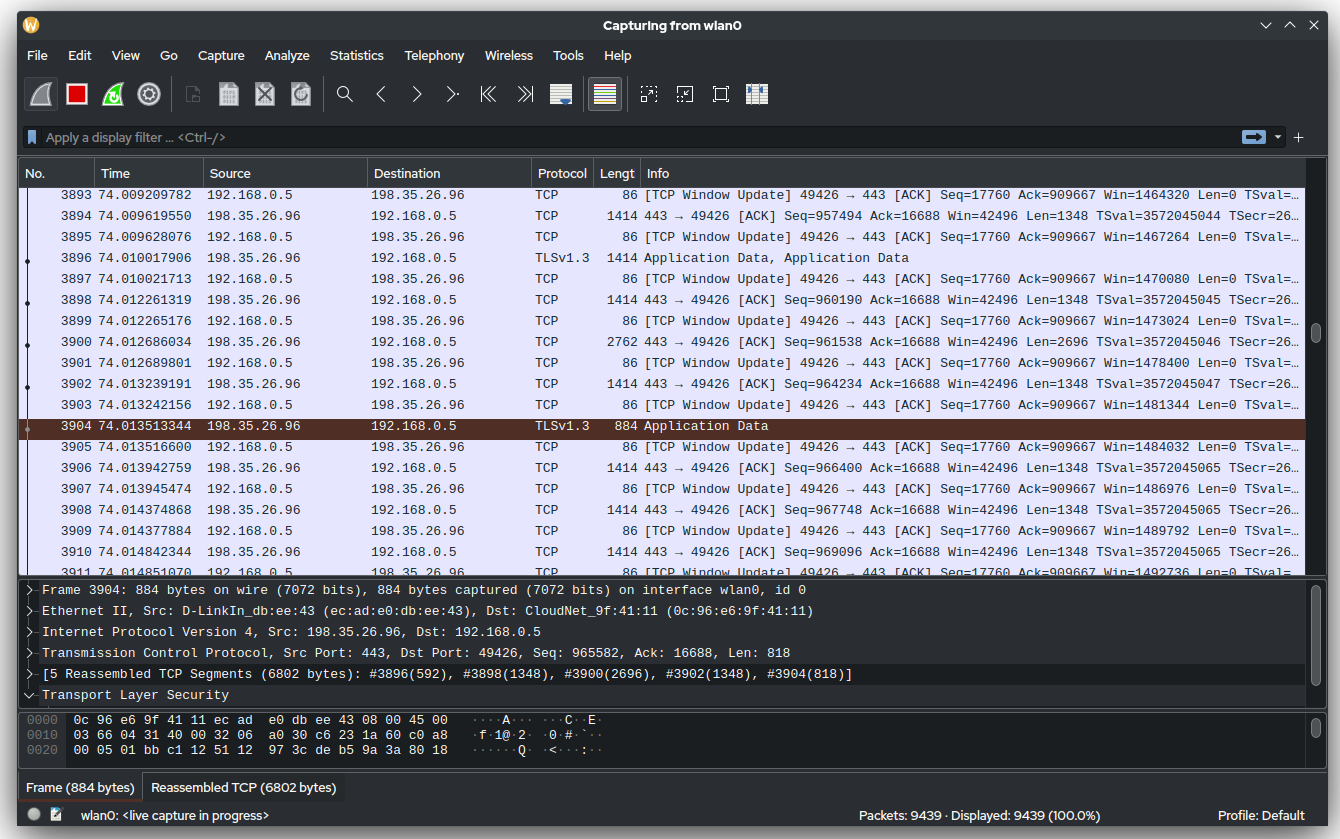
Image credit: Software:The Wireshark teamScreenshot: VulcanSphere, GPL, via Wikimedia Commons
Modern attackers don’t always trigger obvious alarms. They move laterally, live off the land, and blend into normal traffic. That’s why threat hunting has become a core capability for mature security teams.
When we talk about threat hunting, we mean:
- Proactively searching for signs of compromise that tools might miss
- Using hypotheses, intelligence, and experience to guide the search
- Working across logs, endpoints, and network data to confirm or rule out threats
Traditional monitoring, like SIEM alerts or EDR detections, is reactive. Threat hunting is deliberate and proactive. Instead of waiting for an alert, we ask questions such as:
- Is there evidence of command‑and‑control traffic using uncommon ports?
- Are there data exfiltration patterns that look like normal backups but aren’t?
- Has an account started authenticating from unexpected regions or devices?
To answer those questions properly, we need dependable data sources. Endpoint telemetry and logs are important, but they don’t always tell the full story. That’s where packet capture (PCAP) becomes crucial.
Our role at AGR Technology is to bring structure and discipline to this process, using repeatable methods, validated tools, and experienced analysts so your threat hunting program delivers real value, not just more noise.
What Is Packet Capture (PCAP) And How It Works
Packet capture (PCAP) is the process of recording network traffic at the packet level. Instead of just knowing that a connection happened, we can see the actual contents and sequence of the communication.
In practice, PCAP works like this:
- Traffic tap or span: We mirror traffic from switches, routers, firewalls, or cloud environments.
- Capture engine: Specialized software or appliances capture packets in real time.
- Storage: Captured packets are written to disk in a standard format (often .pcap or .pcapng).
- Analysis tools: We search, filter, replay, and inspect traffic using tools like Wireshark or enterprise‑grade network forensics platforms.
Compared to logs or flow data (NetFlow/IPFIX), PCAP gives us:
- Full content: Headers and payloads, where policy and data‑loss violations often live.
- Exact sequence: How a session unfolded, step by step.
- Protocol detail: Every field, option, and anomaly, not just summaries.
For our clients, we typically design PCAP solutions that are:
- Targeted: Capturing the right segments (e.g., internet edge, data centre, cloud VPCs).
- Efficient: Using filters and retention policies to manage storage and performance.
- Accessible: Indexed and searchable so your analysts don’t waste time digging.
This is the foundation that allows our threat hunters to investigate incidents quickly and with confidence.
Why PCAP Is Critical For Effective Threat Hunting
Deep Visibility And Full-Fidelity Evidence
When an incident escalates, from “odd alert” to “possible breach”, the most common gap we see is missing detail. Logs say something happened, but not exactly what. PCAP fills that gap.
With full‑fidelity packet data, we can:
- Reconstruct attacker actions at the network layer
- Validate whether data was actually exfiltrated or just accessed
- Prove if malware callbacks or C2 channels were successful
- Support legal, regulatory, and insurance requirements with concrete evidence
For regulated sectors (finance, healthcare, critical infrastructure), this level of evidence isn’t a luxury. It’s often a compliance expectation.
Bridging The Gap Between Alerts And Root Cause
Security stacks produce a lot of alerts. The hard part is working out root cause:
- Was this a real intrusion or a noisy false positive?
- If it’s real, how did the attacker get in, and what did they do next?
By tying PCAP into your SIEM, EDR, or SOAR platform, we can pivot from an alert to:
- The exact sessions involved (source, destination, ports, protocols)
- The payloads transferred, including files and commands (where legally permissible)
- Any follow‑on connections that show lateral movement or staging
This shortens investigation time and reduces the risk of missing a crucial step in the kill chain.
Comparing Packet-, Endpoint-, And Log-Centric Approaches
Each telemetry type has strengths and weaknesses:
- Logs (firewall, proxy, application):
- Great for high‑level visibility and compliance
- Lightweight and scalable
- Often miss payloads and fine‑grained context
- Endpoint data (EDR/XDR):
- Strong for process, registry, and file activity
- Can be bypassed on unmanaged or legacy systems
- Limited view into unmanaged assets and some network segments
- PCAP / network forensics:
- Independent of endpoint health or logging configuration
- Sees everything crossing the wire (within scoped segments)
- Heavier on storage and analysis if not managed correctly
Our view at AGR Technology is simple: you get the best results when all three are used together. PCAP is the source of truth for what actually traversed the network, while logs and endpoint data give you context and attribution. We design our services to blend these data sources so you get a balanced, efficient detection and response capability.
Key Capabilities Of PCAP-Based Threat Hunting Services
Continuous Versus On-Demand Capture Models
Not every organization needs to capture everything, all the time. We typically help clients choose between:
- Continuous capture on critical segments
- Ideal for high‑risk or regulated environments
- Enables full historical reconstruction of events
- On‑demand or rolling capture
- Short‑term buffers (e.g., last 24–72 hours) with targeted long‑term storage
- Triggered by specific alerts, changes, or incidents
We design the capture approach around your risk profile, budget, and infrastructure, not the other way around.
Storage, Indexing, And Fast Retrieval At Scale
Raw PCAP data can grow quickly. Our services focus on keeping it usable:
- Smart filtering at capture to reduce noise
- Tiered storage and retention policies (hot vs archive)
- Indexing by key attributes (IP, port, protocol, timeframe, user where available)
- Fast search and replay so analysts can answer questions in minutes, not hours
We also help you align retention periods with legal, compliance, and insurance expectations.
Integrations With SIEM, EDR, And NDR Platforms
PCAP is most effective when integrated into your existing stack. We commonly integrate with:
- SIEM platforms (e.g., Splunk, Microsoft Sentinel, Elastic)
- EDR/XDR tools (e.g., Microsoft Defender, CrowdStrike, SentinelOne)
- NDR and IDS/IPS platforms
- SOAR tools for automated playbooks
This lets your SOC team:
- Pivot from an alert to PCAP evidence in a single click
- Enrich incidents with network context
- Automate common investigations and containment steps
AGR Technology can deliver PCAP as a managed service, or work alongside your existing SOC/MDR provider to give them deeper network visibility.
Coverage For Cloud, Encrypted, And Remote Traffic
Modern networks stretch across:
- On‑premises environments
- Public and private cloud (AWS, Azure, GCP)
- Remote workers, VPNs, SD‑WAN, and zero trust networks
We design capture strategies to handle:
- Cloud traffic, using native mirroring (VPC Traffic Mirroring, VTAPs, etc.)
- Encrypted traffic (TLS/SSL), focusing on metadata, SNI, JA3 fingerprints, and where appropriate, lawful decryption at controlled points
- Remote and branch offices, using lightweight sensors or centralized aggregation
The result is a more consistent view of your environment, even as your infrastructure evolves.
Operationalizing Threat Hunting With PCAP
Common PCAP-Centric Threat Hunting Use Cases
We typically see PCAP‑backed threat hunting deliver clear value in scenarios like:
- Investigating suspected data exfiltration or IP theft
- Validating potential command‑and‑control (C2) activity
- Hunting for lateral movement and privilege escalation paths
- Analyzing phishing and malicious email links at the network layer
- Identifying misconfiguration and shadow IT (rogue services, unauthorized apps)
For each client, we help shape a use‑case library so hunts are focused on real risks, not just generic patterns.
Building Hypotheses, Filters, And Queries
Effective hunting starts with a hypothesis, for example:
“An attacker is using DNS tunneling to move data out of the network.”
From there, we build:
- Filters: Narrowing PCAP data to relevant timeframes, hosts, and protocols
- Queries: Looking for unusual record sizes, entropy, query frequency, or domain patterns
- Correlations: Linking suspicious traffic with endpoint or identity data
Our analysts follow a structured process so every hunt:
- Is repeatable and well‑documented
- Produces clear findings and recommendations
- Can be automated or partially automated over time
Incorporating PCAP Into Incident Response Playbooks
PCAP shines during incidents, if it’s wired into your response process. We work with clients to:
- Add PCAP pivot steps into IR playbooks for priority alerts
- Define triage questions that PCAP can answer quickly (e.g., “Was data actually exfiltrated?”)
- Establish clear hand‑offs between SOC analysts, incident responders, and legal/compliance teams
This reduces confusion in high‑pressure situations and gives decision‑makers hard evidence when they need it most.
Skills, Processes, And Metrics For A Mature Program
Tools alone aren’t enough. We help clients mature their program with:
- Skills: Training analysts on network forensics, protocol analysis, and PCAP tools
- Processes: Standard operating procedures for hunts, escalations, and reporting
- Metrics: Time‑to‑detect, time‑to‑contain, false positive rates, and investigation cycle times
Where internal capacity is limited, AGR Technology can provide ongoing managed threat hunting, combining our network expertise with your knowledge of the business.
Evaluating And Choosing A PCAP Service Provider
Security, Privacy, And Compliance Considerations
Capturing network traffic raises valid questions about privacy and data handling. When you assess a provider (including us), you should ask:
- How is captured data encrypted in transit and at rest?
- Who has access to PCAP files and analysis tools?
- Where is data stored (jurisdiction, data residency)?
- How are retention, deletion, and evidence‑handling controlled and audited?
At AGR Technology, we align implementations with relevant standards and guidance, such as ISO 27001 principles and sector‑specific regulatory requirements, and tailor controls to your risk and compliance obligations.
Performance, Scalability, And Cost Models
A good PCAP service must balance depth of visibility with cost and performance. Points to consider:
- Capture rates and throughput on critical links
- Impact on network infrastructure
- Storage growth over time and options for compression
- Pricing for capture, storage, analysis, and managed hunting
We work transparently with clients to size solutions correctly up‑front, avoiding surprises in performance or budget.
Deployment Models And Operational Overhead
Every environment is different, so deployment needs to be flexible. We support:
- On‑premises appliances in data centers
- Virtual sensors in cloud environments
- Hybrid models across multiple sites and providers
We aim to minimize operational overhead by:
- Using automation for updates and configuration management
- Integrating with your existing monitoring and ticketing systems
- Providing clear documentation and runbooks
Support, Training, And Service-Level Expectations
Threat hunting and PCAP are only effective if your team can use them confidently. When we engage with clients, we define:
- Support models: Hours, response times, and escalation paths
- Training: From fundamentals of PCAP analysis to advanced network forensics
- Service levels: Agreed SLAs for investigations, reporting, and incident handling
Our goal is to become an extension of your security team, not just another tool vendor. We bring hands‑on experience from real incident response and network security projects, and we share that knowledge openly so your internal capability grows over time.
Conclusion
Threat hunting without reliable data is guesswork. With packet capture, you get hard evidence, what crossed the wire, when, and how. Combined with structured hunting methods and strong processes, it becomes one of the most powerful tools you can add to your security program.
AGR Technology helps organizations design, deploy, and run threat hunting and PCAP services that are practical, scalable, and defensible. Whether you need:
- A fresh PCAP architecture designed around your environment
- A review and uplift of existing capture and network forensics tools
- Ongoing managed threat hunting and incident investigation support
, we can work with your team to build the level of visibility and assurance you’re aiming for.
If you’re ready to move beyond best‑effort logging and gain clear, defensible insight into what’s happening on your network, we’re here to help.
Next step:
Contact AGR Technology to discuss your environment, risk profile, and current tooling. We’ll provide a straightforward assessment of where PCAP‑backed threat hunting can add the most value, and what a tailored rollout could look like for your organization.
Threat Hunting and Packet Capture (PCAP) Services – FAQs
What are threat hunting and packet capture (PCAP) services?
Threat hunting and packet capture (PCAP) services combine proactive detection with deep network visibility. Threat hunting involves systematically searching for signs of compromise across logs, endpoints, and network data. PCAP records network traffic at the packet level, providing full‑fidelity evidence so analysts can reconstruct events, validate exfiltration, and prove what actually happened.
Why is PCAP critical for effective threat hunting?
PCAP gives full‑content visibility into network sessions, including headers, payloads, and protocol details. This lets analysts move from high‑level alerts to concrete evidence—reconstructing attacker activity, verifying whether data left the network, and supporting legal or regulatory needs. It fills gaps left by logs and endpoint data, especially in complex or regulated environments.
How do AGR Technology’s threat hunting and PCAP services integrate with existing security tools?
AGR Technology designs PCAP and threat hunting services to integrate with SIEM, EDR/XDR, NDR, IDS/IPS, and SOAR platforms. Analysts can pivot from an alert to related packet data in a click, enrich incidents with network context, and automate repeatable investigations, reducing time‑to‑detect and time‑to‑contain across your environment.
What deployment options are available for PCAP-based threat hunting services?
PCAP-based threat hunting services can be deployed via on‑premises appliances, virtual sensors in cloud environments, or hybrid models. AGR Technology tailors capture points for data centers, cloud VPCs, remote sites, and VPNs, while using automation, clear runbooks, and integrations with existing monitoring and ticketing tools to minimize operational overhead.
How much data does PCAP generate and how is storage managed?
PCAP can generate large volumes of data, especially on high‑throughput links. Best practice is to use targeted capture, filters, and rolling buffers, combined with tiered storage (hot vs archive) and compression. Indexing by IP, ports, protocols, and time enables fast querying without having to keep everything in expensive, high‑performance storage indefinitely.
Is packet capture legal and how do organizations address privacy concerns?
Packet capture is generally legal when done on networks you own or manage and in line with applicable laws, contracts, and policies. Organizations mitigate privacy risks by limiting capture scope, encrypting data at rest and in transit, enforcing strict access controls, defining retention and deletion policies, and aligning practices with standards like ISO 27001 and data protection regulations.
Other resources:
Essential Eight Compliance Services
Expert Penetration Testing Services in Australia
Cyber Security Services For Law Firms
Cyber Security Audits for Clinics
Threat Detection, Investigation And Response (TDIR) Services
Information Security Policy Uplift

Alessio Rigoli is the founder of AGR Technology and got his start working in the IT space originally in Education and then in the private sector helping businesses in various industries. Alessio maintains the blog and is interested in a number of different topics emerging and current such as Digital marketing, Software development, Cryptocurrency/Blockchain, Cyber security, Linux and more.
Alessio Rigoli, AGR Technology