![logo-new-23[1]](https://agrtech.com.au/wp-content/uploads/elementor/thumbs/logo-new-231-qad2sqbr9f0wlvza81xod18hkirbk9apc0elfhpco4.png "logo-new-23[1]")
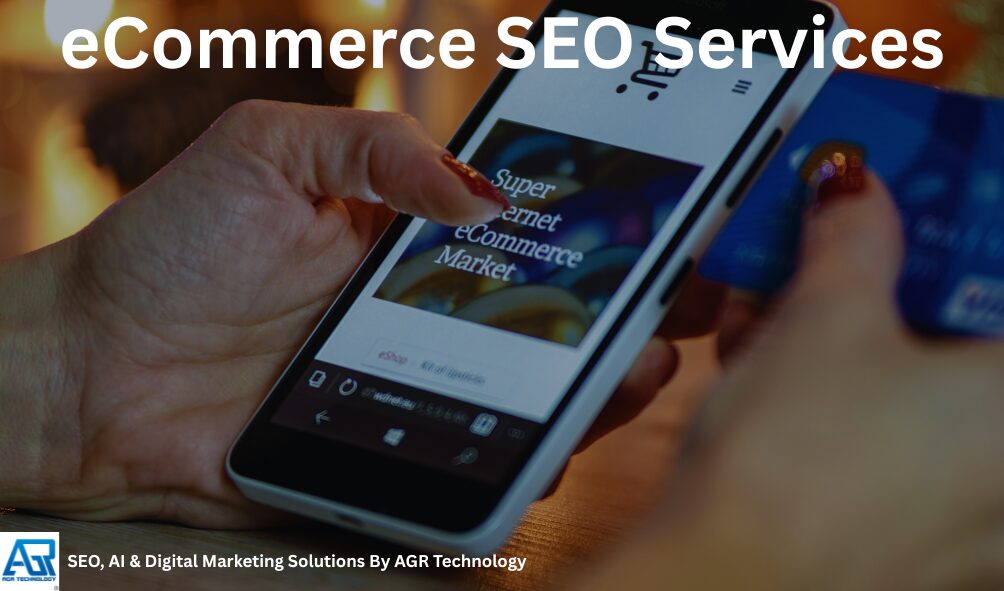
If you’re running an online store, you’ve probably felt the frustration of spending on ads, tweaking your site, and still wondering why sales aren’t where they should be.
Your products are good. Your customers love you once they find you. The real problem? Not enough of the right people are actually finding you in search.
That’s exactly where a specialist eCommerce SEO agency like AGR Technology comes in.
In this guide, we’ll walk you through what makes eCommerce SEO different, which services actually move the needle, what timelines and ROI to expect, and how to choose the right agency partner for your store. By the end, you’ll know what to look for, what to avoid, and how we can help you grow organic revenue in a predictable, sustainable way.
Get in contact with our team for a fully bespoke SEO campaign proposal
Reviews from our happy clients:

Justine Brummans
Alessio is both incredibly knowledgeable and personable! He gave me great advice that was catered to me and my situation. Thank you Alessio! Super helpful!

Springfield Equestrian Park
Alessio is amazing! I can not speak highly enough of how helpful and knowledgeable he is, my website he created far exceeded my expectations, he is so accomodating and I can only wish him every success with his business. I rate AGR technology 10 out of 10.
Legacy Energy
We used AGR Technology and dealt with Alessio to design and build our website as well as host our emails. Alessio was a pleasure to deal with and had plenty of ideas that we could implement into our site. He has a great attention to detail, he is also very polite in understanding our goals and what we wanted to achieve with our website.
Thanks mate,
Alex & Rob
Excellent Service
Alessio developed our website for our business and has done a wonderful job. He is very personable and knowledgeable. We have enjoyed working with him. We will be referring others to him and highly recommend him to those who need Tech advice.
MRC Performance
I have been in business for over 10 Years and recently moved to AGR Technology for all our IT needs. They are able to fix nearly anything remotely and always very helpful in recommending appropriate hardware upgrades that do the job as required but not costing more than needed.

Alessio provided an excellent service. He was very dedicated in his method of finding solutions to problems. He continued to try different avenues until he found the reason as to why a particular application was not working. He was very knowledgeable in his understanding of the internet and of applications and how they work, and he was able to apply this knowledge in understanding how to resolve the obstacles that continued to appear. He is understanding towards his client's needs and goals and he is willing to work with his client in achieving those goals. He is a very polite and well mannered person and very calm and gentle in his approach. I would highly recommend Alessio's services to anyone.

Palmira Rigoli
Great work ethics Alessio! We at Totally Gluten Free Products are very happy to have you on board as our IT and SEO master. Very reliable, trustworthy and knowledgeable in the field.
YouTube Comment
Nat's Custom Designs
Alessio from AGR Technology has recently helped me create a website for my business.
Throughout the whole process from start to finish Alessio made the process easy for me, by calling me and explaining each step of the way. I'm not very computer savvy, but with Alessio taking the time to explain in detail everything I needed to know from putting inventory in to having it shipped. He even remotely joined my computer to help guide me through everything.
He's very knowledgeable and is experienced in everything I needed and if there was anything else I needed to know that wasn't something he was familiar with, he researched it.
I would HIGHLY recommend Alessio to anyone. He has not only helped me for now but I know that if I ever needed help with anything else he would definitely go above and beyond to help. Thank you so much for everything you have done. It's been a long process but well worth it 🙂
Byron Macumber
AGR Technology is amazing. not only do they stick with you through out the process, they also accommodate to your wants and needs. They are efficient in their work and they have high integrity. Their capabilities are shown through their website design, and appropriate knowledge of utilities regarding software. over the many years of working with them they have been fantastic. I would recommend to everyone
Very helpful
Alessio was thorough, diligent and kept me updated at all time points. I was very impressed with his performance, passion and dedication. I will continue to use his services.
Wantrup & Associates
Alessio of AGR Technology is an IT guy we rely on whenever we need IT help. His professionalism impressed us right at the first time. He solved many of our IT problems in no time. Excellent communication and speedy response.
We highly recommend this company
From a happy customer
Valeria Bianco
I received AGR contact information from a previous client, who had found their service excellent. So I contacted AGR with some expectations, and I can say they exceeded them. Professional, honest, punctual, reliable, their service is faultless. We can't recommend them highly enough.
Very fast, value for money and a comprehensive service
AGR is professional, organised and very skilled at what they do. They take the initiative, looking after all the details that you would not have thought of to enhance your website presence, marketing funnel and automated appointment bookings. Big bonus - pricings are at a fraction of the cost of competitors.
Customer testimonial
Alessio from AGR Technology is wonderful at gently guiding the less technically savvy users to solve problems. Back up service excellent. Highly recommended
SEO for website
The team is very cooperative and delivers clean and very efficient work.

Raimond Volpe
Nothing but good things to say about Alessio. He has been great service and great at communicating with me by both phone and email. Very good knowledge and problem-solving ability with our web development. I would thoroughly recommend Alessio and AGR Technology to anyone wanting online marketing or web development
Website design
Big thank you to Alessio at AGR Technology for a smooth and easy website development process. Nothing was to difficult to accomplish, I can highly recommend his first class service.
Proudly supporting clients of all sizes to succeed through digital solutions







Why work with us?






Contact us today to find out how our SEO consultants can help take your online presence to the next level.
What Is An eCommerce SEO Agency And How Is It Different From Standard SEO?

An eCommerce SEO agency focuses specifically on helping online stores grow organic traffic and revenue from search engines. Instead of just chasing rankings for a few keywords, we work across your products, categories, filters, and content to make sure searchers can actually buy from you.
At AGR Technology, we work with retail and DTC brands across Australia and beyond, helping them turn search visibility into real orders, higher average order value, and better margins.
Core Differences Between eCommerce SEO And Traditional SEO
Standard SEO is usually about:
- Ranking a handful of service or blog pages
- Driving leads, form fills, or calls
- Publishing long-form content to capture information searches
eCommerce SEO, on the other hand, is built around:
- Product and category pages as primary revenue drivers
- Scalable optimisation for hundreds or thousands of SKUs
- Product data and feeds (titles, attributes, structured data)
- Shopping experiences across Google Search, Shopping, and other marketplaces
- Conversion and revenue, not just clicks
Key ways eCommerce SEO is different:
- Volume and complexity
You’re not optimising 20 pages – you may be optimising 2,000. That means templates, automation, and very structured site architecture become critical.
- Commercial intent
We focus heavily on bottom-of-funnel keywords: product names, brands, categories, and long-tail queries that show buying intent.
- Inventory and seasonality
Products go in and out of stock. Ranges change. We need strategies to manage discontinued items, variants, and seasonal collections without losing SEO value.
- Technical performance under load
Large catalogues plus apps, plugins, and third-party scripts often slow stores down. Technical SEO and performance tuning matter more.
A specialist eCommerce SEO agency understands these moving parts and builds strategies that scale with your catalogue and operations.
When You Should Hire A Specialist eCommerce SEO Agency
You don’t always need an agency from day one. But there are clear signs it’s time to bring in a dedicated eCommerce SEO partner like AGR Technology:
- Your paid ads are driving sales, but organic isn’t
You’re too dependent on Google Ads or social ads and want to reduce acquisition costs.
- You have a growing product catalogue
Once you move past a small range, DIY SEO starts to break. Template issues, thin content, and duplicate pages creep in.
- You’ve migrated or are about to migrate platforms
Moving to Shopify, WooCommerce, Magento, or BigCommerce without a plan can cost you years of SEO equity.
- Your store has stalled in growth
Sessions might be up, but revenue isn’t. Or rankings are stuck on page two and three.
- You’re planning to scale nationally or internationally
You need structured data, international SEO, local signals, and content strategy aligned with your expansion.
If any of this sounds familiar, we can step in, audit where you are now, and build a clear roadmap to grow sales from organic search.
Want a straight answer on whether SEO is worth it for your store right now? Talk to AGR Technology for a free initial consultation.
Key Benefits Of Working With An eCommerce SEO Agency

A good eCommerce SEO agency isn’t just another vendor: it’s a growth partner. Here’s what you should expect when you work with a specialist team like ours.
Increased Qualified Traffic And Revenue, Not Just Rankings
We’re not interested in vanity metrics. Rankings are only useful if they lead to sales.
When we work on eCommerce SEO, we focus on:
- Commercial keywords: product names, categories, brands, and buying-intent phrases
- Search terms that match your margins: promoting the products and ranges that actually make you money
- On-site conversion improvements: title tags, descriptions, UX tweaks, and trust signals that help visitors complete checkout
We measure success in:
- Revenue from organic search
- Conversion rate from organic sessions
- Average order value
- Profit, not just top-line sales
The result is more people who actually want what you sell, landing on pages designed to convert.
Better Product Discovery Across Categories, Search, And Shopping
If customers can’t easily find your products – on your site or via Google – you’re leaving money on the table.
We improve product discovery by:
- Structuring categories and subcategories logically
- Optimising product titles, meta descriptions, and on-page copy
- Implementing structured data (schema) for products, reviews, and pricing
- Cleaning up faceted navigation so search engines can crawl and index the right pages
- Aligning your on-site search and filters with real search behaviour
This doesn’t just help Google: it helps human shoppers. They can browse by brand, use filters, search specific attributes, and land on pages that make sense.
Stronger Brand Visibility And Customer Lifetime Value
eCommerce SEO isn’t only about the first sale. It’s also about keeping customers coming back.
We use SEO to strengthen your brand by:
- Creating helpful guides and FAQs that build trust and authority
- Targeting comparison and “best of” queries so you appear early in the research phase
- Showcasing reviews, UGC, and social proof in search results
- Supporting content that can feed your email and social channels
This combination improves customer lifetime value (CLV):
- More organic touchpoints across the customer journey
- Higher repeat purchase rates
- Better brand recall when customers are ready to buy again
If you want your store to be the default choice in your niche, not just another store in the results, SEO-led brand visibility is key. Reach out to AGR Technology to see how we’d approach this for your market.
Essential Services Every eCommerce SEO Agency Should Offer

Not all SEO service lists are created equal. For an online store, there are a few non-negotiables your eCommerce SEO agency must cover.
Technical And On-Page SEO For Product And Category Pages
Your product and category templates are the engine of your organic revenue. We typically focus on:
Product page optimisation
- SEO-friendly product titles and H1s
- Unique, benefit-led descriptions (no copy-paste from suppliers)
- Structured data for price, availability, ratings
- Optimised images, file names, and alt text
Category and collection page optimisation
- Clear, keyword-informed naming
- Intro copy to provide context (without pushing products below the fold)
- Filters and sort options that help both users and search engines
Technical hygiene
- Crawlability and indexation
- Site speed and Core Web Vitals
- Mobile usability and responsive design
- Fixing 404s, redirects, and duplicate content issues
Site Architecture, Faceted Navigation, And Internal Linking
For larger catalogues, how your site is structured can make or break your SEO.
We work on:
- Clear site architecture
Logical categories, subcategories, and collections so users (and bots) don’t get lost.
- Faceted navigation control
Managing filters (size, colour, price, brand) so they help users without creating endless duplicate URLs.
- Internal linking strategy
- Linking from category pages to key products
- Cross-linking between related categories
- Using internal search data to surface popular items
Done well, this increases crawl efficiency and helps your most valuable pages gain authority.
Content Strategy For Product, Category, And Informational Pages
Content for an online store is more than just blog posts.
We help you build a content strategy that includes:
- Deep product content: FAQs, sizing guides, care instructions, comparison tables
- Category-level content: buying guides, trend overviews, and educational snippets
- Informational content: articles that answer real questions your customers are asking before they buy
This helps you:
- Capture traffic earlier in the buying journey
- Reduce returns with clearer product information
- Build authority and trust in your niche
Off-Page SEO, Digital PR, And Link Building For Online Stores
Links and brand mentions still matter for SEO – particularly in competitive eCommerce categories.
For stores, off-page SEO might include:
- Digital PR campaigns (stories that tie into your products or mission)
- Collaborations with creators, bloggers, and niche publications
- Resource content that naturally attracts links
- Fixing unlinked brand mentions and supplier/partner links
We avoid spammy link schemes. Instead, we focus on sustainable, high-quality tactics that stand up over time.
Measurement, Reporting, And Ongoing Optimization
Without clear reporting, it’s impossible to know what’s working.
At AGR Technology, we typically track:
- Organic traffic by channel and landing page
- Revenue and conversion rate from organic search
- Rankings for priority keywords and product groups
- Technical health scores and Core Web Vitals
We provide regular updates in plain language and tie everything back to commercial outcomes: revenue, profit, and acquisition costs.
If your current reports are pages of charts with no clear actions, we can help you get clarity. Ask us for a sample eCommerce SEO report.
The eCommerce SEO Process: From Audit To Ongoing Growth

A strong eCommerce SEO strategy isn’t guesswork. It follows a clear process so you know what’s happening and why.
Here’s how we typically structure our work with online retailers.
Discovery, Goal Setting, And Baseline Benchmarking
We start by understanding your business, not just your website.
- Who your customers are and how they buy
- Your most profitable categories and products
- Current marketing mix (paid, email, social, marketplaces)
- Target markets (local, national, international)
We also agree on clear goals, such as:
- Increasing organic revenue by a set percentage
- Lifting conversion rates for specific categories
- Reducing reliance on paid search
Then we benchmark your current performance so we can measure real improvement.
Comprehensive eCommerce SEO Audit
Next, we run a detailed audit tailored to eCommerce. This usually covers:
- Technical SEO: crawl issues, indexation, speed, mobile usability
- On-page SEO: titles, headings, meta descriptions, content quality
- Site architecture and internal linking
- Category and product template quality
- Structured data implementation
- Content gaps and keyword opportunities
- Competitor landscape
We don’t just hand over a 60-page PDF. We translate the findings into clear issues, impact, and recommended actions.
Roadmap, Prioritization, And Implementation
From the audit, we build a practical roadmap.
We prioritise by:
- Impact on revenue
- Implementation effort
- Risk (especially around site changes and migrations)
Typical phases might include:
- Quick wins – fixes and tweaks that can lift performance fast
- Structural fixes – architecture, navigation, templates
- Content development – key product, category, and informational content
- Off-page and PR – once on-site foundations are solid
Implementation can be done by our team, your in-house devs and marketers, or a mix. We stay closely involved to make sure changes are applied correctly.
Testing, CRO, And Continuous Improvement
SEO isn’t set-and-forget.
We continually:
- Test different title tags and meta descriptions
- Refine product and category copy based on search behaviour
- Adjust internal links as product ranges change
- Monitor search trends and seasonality
We often blend conversion rate optimization (CRO) with SEO, because improving how your pages convert can lift revenue faster than chasing more traffic alone.
If you want a clear, step-by-step plan for your store, we can map out an initial 90-day eCommerce SEO roadmap. Get in touch with AGR Technology to get started.
Platform Expertise: Shopify, WooCommerce, Magento, BigCommerce And More

Your platform shapes what’s easy, what’s hard, and what’s possible with SEO.
We work across major eCommerce platforms including Shopify, WooCommerce, Magento (Adobe Commerce), BigCommerce, and custom builds.
What Platform-Specific SEO Experience Really Looks Like
Real platform expertise goes beyond “we’ve used it before”. It means:
- Knowing how each platform handles URLs, canonical tags, and sitemaps
- Understanding where theme and plugin conflicts usually appear
- Using the right apps or extensions without bloating your site
- Knowing which settings matter for SEO and which are safe to ignore
For example:
- On Shopify, we often tackle duplicate content from /collections/ and /products/ URLs and manage limited control over certain technical settings.
- On WooCommerce, we pay close attention to plugin conflicts, performance, and structured data from themes.
- On Magento/Adobe Commerce, we focus on layered navigation, indexation rules, and performance tuning.
- On BigCommerce, we leverage built-in SEO features but still fine-tune URL structures and template content.
Common SEO Pitfalls On Popular eCommerce Platforms
Some of the most common issues we see include:
- Auto-generated, non-unique meta titles and descriptions
- Thin or duplicate product descriptions from suppliers
- Faceted navigation creating thousands of low-value URLs
- Slow page load times due to heavy apps, scripts, or large images
- Missing or broken structured data
- Weak internal linking from category to product level
These issues are fixable, but they often need someone who’s seen them many times before.
How A Good Agency Works With Your Developers And Apps
We don’t try to bulldoze your tech setup. A good eCommerce SEO agency works with your developers and tools.
That usually looks like:
- Providing clear, developer-friendly tickets and documentation
- Joining sprint planning or check-in calls when needed
- Recommending apps or plugins that balance SEO, UX, and performance
- Testing changes in staging where possible, especially for larger stores
We respect your workflows. Our role is to guide and de-risk SEO changes so you don’t lose traffic or break important functionality.
If you’re unsure whether your current platform setup is helping or hurting your organic growth, AGR Technology can run a platform-specific SEO review and walk you through the findings.
Conclusion
Next Steps To Find The Right eCommerce SEO Agency For Your Store
Choosing the right eCommerce SEO agency is less about buzzwords and more about fit, experience, and transparency.
To move forward confidently, we suggest you:
- Clarify your goals – revenue targets, key categories, and timelines.
- Assess your current SEO health – even a simple review of analytics, search console, and key pages can reveal a lot.
- Shortlist agencies with clear eCommerce experience – not just generic SEO.
- Ask direct questions about process, communication, and expected outcomes.
If you want a partner who understands both the technical and commercial side of running an online store, we’d be glad to talk.
At AGR Technology, we can help eCommerce brands grow organic revenue with clear strategy, careful implementation, and honest reporting. No gimmicks, no inflated promises.
Ready to see what’s possible for your store?
- Book a call with our team to discuss your goals and challenges.
- Request an eCommerce SEO audit to uncover quick wins and long-term opportunities.
- Or send us your site URL and we’ll outline how we’d approach your SEO over the next 90 days.
Your customers are already searching. Our job is to make sure they find you first – and choose you again and again.
Frequently Asked Questions About eCommerce SEO Services
What does an eCommerce SEO agency do for an online store?
An eCommerce SEO agency focuses on increasing organic revenue for online stores by optimizing product and category pages, improving site architecture, fixing technical issues, and creating strategic content. Instead of chasing vanity rankings, the goal is more qualified traffic, higher conversion rates, and better profit from organic search.
How is an eCommerce SEO agency different from a standard SEO agency?
A specialist eCommerce SEO agency is built around product and category pages, large SKU volumes, and commercial-intent keywords. It manages inventory changes, seasonality, technical performance under load, and product data feeds. Standard SEO often centers on a few service or blog pages and lead generation, not complex catalogs and transactions.
When should I hire a specialist eCommerce SEO agency for my store?
It’s time to hire an eCommerce SEO agency when you rely heavily on paid ads, your catalog is growing, you’re planning or have done a platform migration, growth has stalled, or you’re expanding nationally or internationally. An agency can audit your store, protect existing equity, and create a roadmap for scalable organic growth.
What services should every good eCommerce SEO agency offer?
Core services include technical and on-page SEO for product and category templates, site architecture and faceted navigation optimization, internal linking strategies, content for product, category, and informational pages, and off-page SEO such as digital PR and link building. Ongoing measurement, reporting, and continuous optimization are also essential for long-term performance.
How long does eCommerce SEO take to show results?
Timelines vary by site health, competition, and implementation speed. Typically, 1–3 months covers quick wins and technical fixes, 3–6 months brings noticeable traffic and revenue lifts for priority categories, and 6–12+ months builds stronger rankings across the catalog. SEO compounds over time, with early work driving returns for years.
How do I choose the best eCommerce SEO agency for my business?
Look for agencies with proven eCommerce case studies, platform-specific expertise (Shopify, WooCommerce, Magento, BigCommerce), and a clear process from audit to ongoing optimization. Ask how they measure success, who you’ll work with, and what the first 90 days look like. Avoid guaranteed rankings and unclear, link-heavy tactics.
Related resources: