![logo-new-23[1]](https://agrtech.com.au/wp-content/uploads/elementor/thumbs/logo-new-231-qad2sqbr9f0wlvza81xod18hkirbk9apc0elfhpco4.png "logo-new-23[1]")
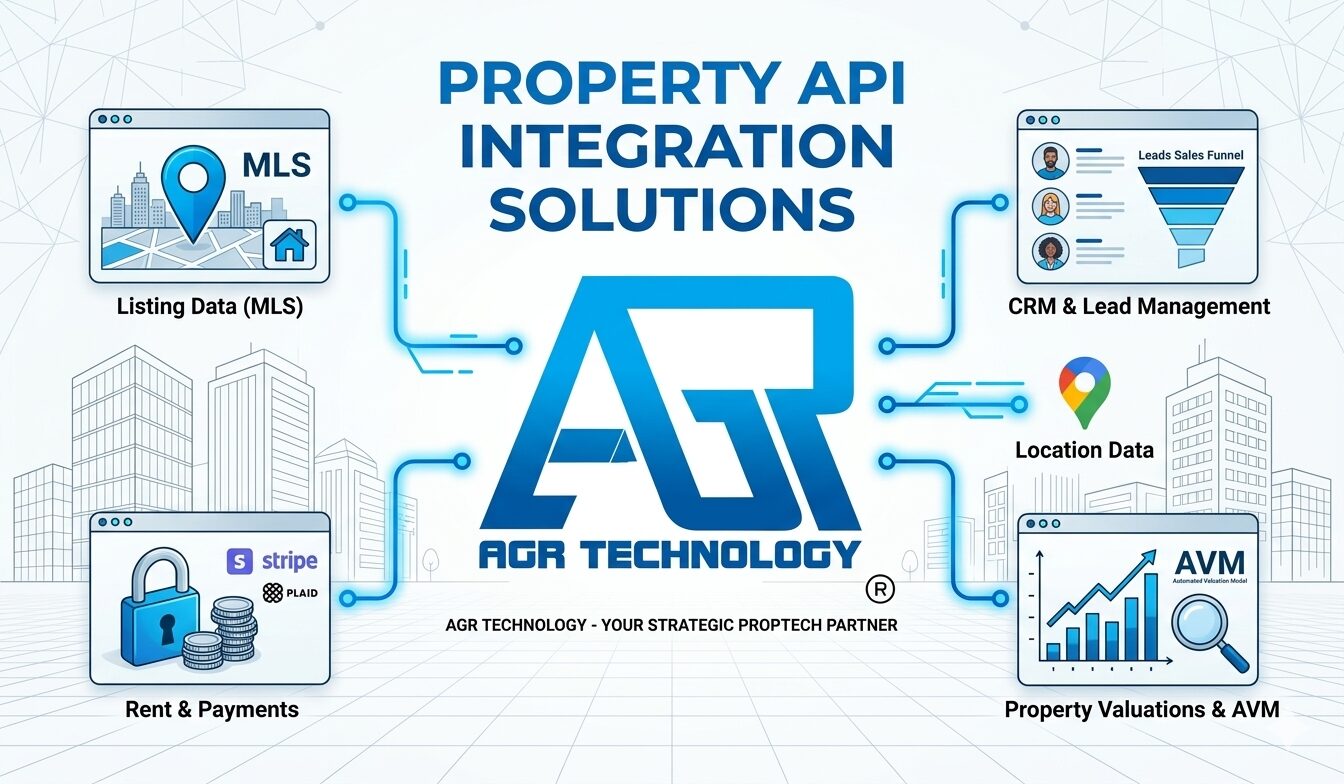
If your business relies on property data, manual entry and disconnected systems usually become a bottleneck fast. Listings go out of date, teams waste time switching between platforms, and reporting becomes harder than it should be.
That’s where Property API Integration Solutions come in. We help businesses connect property data sources with websites, CRMs, internal software, marketing tools, and operational workflows so information moves where it needs to, when it needs to. The result is simpler processes, better visibility, and fewer avoidable errors.
At AGR Technology, we can build tailored integration solutions for businesses that want dependable data flow, practical automation, and systems that scale with growth. Whether you need listing feeds, valuation data, workflow automation, or a custom portal, this page explains what matters, what to look for, and how to choose the right approach.
Get in contact with us to discuss your project
What our clients are saying

Justine Brummans
Alessio is both incredibly knowledgeable and personable! He gave me great advice that was catered to me and my situation. Thank you Alessio! Super helpful!

Springfield Equestrian Park
Alessio is amazing! I can not speak highly enough of how helpful and knowledgeable he is, my website he created far exceeded my expectations, he is so accomodating and I can only wish him every success with his business. I rate AGR technology 10 out of 10.
Legacy Energy
We used AGR Technology and dealt with Alessio to design and build our website as well as host our emails. Alessio was a pleasure to deal with and had plenty of ideas that we could implement into our site. He has a great attention to detail, he is also very polite in understanding our goals and what we wanted to achieve with our website.
Thanks mate,
Alex & Rob
Excellent Service
Alessio developed our website for our business and has done a wonderful job. He is very personable and knowledgeable. We have enjoyed working with him. We will be referring others to him and highly recommend him to those who need Tech advice.
MRC Performance
I have been in business for over 10 Years and recently moved to AGR Technology for all our IT needs. They are able to fix nearly anything remotely and always very helpful in recommending appropriate hardware upgrades that do the job as required but not costing more than needed.

Alessio provided an excellent service. He was very dedicated in his method of finding solutions to problems. He continued to try different avenues until he found the reason as to why a particular application was not working. He was very knowledgeable in his understanding of the internet and of applications and how they work, and he was able to apply this knowledge in understanding how to resolve the obstacles that continued to appear. He is understanding towards his client's needs and goals and he is willing to work with his client in achieving those goals. He is a very polite and well mannered person and very calm and gentle in his approach. I would highly recommend Alessio's services to anyone.

Palmira Rigoli
Great work ethics Alessio! We at Totally Gluten Free Products are very happy to have you on board as our IT and SEO master. Very reliable, trustworthy and knowledgeable in the field.
YouTube Comment

Nat's Custom Designs
Alessio from AGR Technology has recently helped me create a website for my business.
Throughout the whole process from start to finish Alessio made the process easy for me, by calling me and explaining each step of the way. I'm not very computer savvy, but with Alessio taking the time to explain in detail everything I needed to know from putting inventory in to having it shipped. He even remotely joined my computer to help guide me through everything.
He's very knowledgeable and is experienced in everything I needed and if there was anything else I needed to know that wasn't something he was familiar with, he researched it.
I would HIGHLY recommend Alessio to anyone. He has not only helped me for now but I know that if I ever needed help with anything else he would definitely go above and beyond to help. Thank you so much for everything you have done. It's been a long process but well worth it 🙂
Byron Macumber
AGR Technology is amazing. not only do they stick with you through out the process, they also accommodate to your wants and needs. They are efficient in their work and they have high integrity. Their capabilities are shown through their website design, and appropriate knowledge of utilities regarding software. over the many years of working with them they have been fantastic. I would recommend to everyone
Very helpful
Alessio was thorough, diligent and kept me updated at all time points. I was very impressed with his performance, passion and dedication. I will continue to use his services.
Wantrup & Associates
Alessio of AGR Technology is an IT guy we rely on whenever we need IT help. His professionalism impressed us right at the first time. He solved many of our IT problems in no time. Excellent communication and speedy response.
We highly recommend this company
From a happy customer
Valeria Bianco
I received AGR contact information from a previous client, who had found their service excellent. So I contacted AGR with some expectations, and I can say they exceeded them. Professional, honest, punctual, reliable, their service is faultless. We can't recommend them highly enough.
Very fast, value for money and a comprehensive service
AGR is professional, organised and very skilled at what they do. They take the initiative, looking after all the details that you would not have thought of to enhance your website presence, marketing funnel and automated appointment bookings. Big bonus - pricings are at a fraction of the cost of competitors.
Customer testimonial
Alessio from AGR Technology is wonderful at gently guiding the less technically savvy users to solve problems. Back up service excellent. Highly recommended
SEO for website
The team is very cooperative and delivers clean and very efficient work.

Raimond Volpe
Nothing but good things to say about Alessio. He has been great service and great at communicating with me by both phone and email. Very good knowledge and problem-solving ability with our web development. I would thoroughly recommend Alessio and AGR Technology to anyone wanting online marketing or web development
Website design
Big thank you to Alessio at AGR Technology for a smooth and easy website development process. Nothing was to difficult to accomplish, I can highly recommend his first class service.
Proudly supporting clients of all sizes to succeed through digital solutions













Why work with us?






What Property API Integration Solutions Are And Why They Matter

Property API integration solutions connect external property data services with the tools your business already uses. In simple terms, an API lets one platform securely send and receive data from another. In the property space, that can include listings, pricing data, valuation data, ownership records, mapping information, rental information, inspection workflows, and lead data.
For many businesses, the issue isn’t access to data. It’s what happens after the data arrives. If teams are copying information between systems, updating records by hand, or working from incomplete datasets, efficiency drops and mistakes creep in.
A well-planned property API integration can help you:
- Reduce manual data entry
- Keep listing and property information current
- Connect websites, CRMs, ERPs, and internal platforms
- Improve reporting and business visibility
- Automate lead handling and operational tasks
- Create better customer and client experiences
This matters across more than just real estate agencies. Property developers, finance providers, proptech companies, marketing teams, facility managers, insurance businesses, and enterprise organisations can all benefit from connected property data.
We approach integrations with a commercial lens. That means we don’t just ask, “Can these systems connect?” We ask, “Will this save time, reduce friction, improve service delivery, or support growth?” That’s the difference between a basic connection and a useful business solution.
Core Use Cases For Property API Integrations
Property API integrations can support a wide range of business functions. The right setup depends on your systems, your data sources, and how your team actually works day to day.
Listings, Valuation, And Market Data
One of the most common use cases is syncing property listings and related market data across platforms. Businesses often need data to move between supplier feeds, websites, mobile apps, CRMs, and reporting systems.
Typical examples include:
- Importing listings into a website automatically
- Syncing price changes and status updates in near real time
- Displaying suburb, sales, or valuation insights alongside listings
- Pulling market data into internal analytics tools
- Standardising data from multiple providers into one format
This is especially useful when speed and accuracy matter. If listing details are delayed or inconsistent, it affects customer trust and can create operational headaches for sales and support teams.
Property Management And Workflow Automation
APIs can also streamline recurring operational tasks. Instead of treating property management, maintenance, and service workflows as separate admin-heavy processes, integrations can move information automatically between platforms.
Examples include:
- Creating jobs when a maintenance request is submitted
- Syncing tenant, owner, or property records between systems
- Triggering alerts for inspections, renewals, or compliance tasks
- Generating invoices or status updates based on workflow events
- Reducing duplicate data across management software and internal tools
This kind of automation helps businesses reduce delays and create a more consistent service experience. It also gives managers clearer oversight because actions are recorded across connected systems rather than buried in inboxes or spreadsheets.
CRM, Marketing, And Lead Enrichment
For many businesses, property data has value beyond operations. It can improve sales workflows, audience segmentation, and campaign performance too.
An API integration may help you:
- Enrich incoming leads with location or property-related context
- Route leads to the right team based on rules or geography
- Personalise email and SMS campaigns using property attributes
- Connect website enquiry forms to your CRM in real time
- Build audience segments for remarketing and sales follow-up
When CRM and marketing systems are connected properly, teams can respond faster and communicate more accurately. That matters whether you’re nurturing investor leads, qualifying enquiries, or supporting a sales pipeline tied to location-based services.
Key Features To Look For In A Property API Solution
Not all APIs, and not all integration setups, are equal. The right solution needs to fit your technical environment, business goals, and risk profile.
Data Coverage, Accuracy, And Update Frequency
Start with the quality of the underlying data. Good integration work can’t compensate for poor source data.
We recommend assessing:
- Geographic coverage relevant to your market
- Completeness of fields and record consistency
- Update frequency and freshness of data
- Support for historical, current, and status-based information
- How exceptions, missing records, and duplicates are handled
If your teams rely on accurate listings, valuation data, or property records, stale or inconsistent feeds can create downstream issues quickly.
Security, Authentication, And Compliance
Security should never be an afterthought, particularly where customer, property, or business-sensitive data is involved. A reliable property API solution should support secure authentication and appropriate access controls.
Important considerations include:
- API keys, OAuth, or token-based authentication
- Encrypted data transfer using HTTPS/TLS
- Role-based access where needed
- Logging and monitoring for troubleshooting and auditing
- Compliance requirements relevant to your business and region
Australian businesses may also need to consider obligations under the Privacy Act 1988, especially where personal information is being processed or stored across connected systems.
Documentation, Support, And Scalability
A technically capable API is only part of the picture. Documentation quality, vendor support, and the ability to scale are just as important.
Look for:
- Clear developer documentation and example endpoints
- Stable versioning and change management practices
- Realistic rate limits and performance expectations
- Responsive technical support
- Flexibility for custom workflows and future expansion
We’ve seen businesses choose a data source based on headline features alone, only to run into avoidable delays because the docs were thin or the support process was slow. In practice, those details matter a lot.
Common Integration Approaches For Businesses
There isn’t a single best way to carry out a property API integration. The right approach depends on your budget, internal capability, software stack, and long-term plans.
Direct API Integration With Internal Systems
This approach connects the property data source directly to your internal platforms, website, CRM, app, or software environment.
It’s often the best fit when you need:
- Full control over business logic
- Tailored data mapping and transformation
- Strong performance and reliability
- Integration with custom software or legacy systems
- Room to scale over time
Direct integration usually requires more planning and development work upfront, but it offers flexibility and control that off-the-shelf options often can’t.
Middleware And Automation Platforms
In some cases, middleware tools or automation platforms can act as the bridge between systems. This can be useful when businesses want to connect platforms quickly without building every process from scratch.
This approach may suit organisations that want to:
- Connect standard SaaS tools
- Automate simple workflow steps
- Reduce development time for basic use cases
- Test integration concepts before deeper custom work
That said, middleware is not always the right long-term answer. Complex workflows, large data volumes, or strict performance needs often call for a more tailored solution.
Custom Dashboards And Client Portals
Sometimes the integration itself is only part of the requirement. Businesses may also need a practical interface where teams, partners, or clients can view and use the connected data.
We often help businesses build:
- Internal dashboards for operations and reporting
- Custom portals for staff, clients, or franchise networks
- Searchable property data interfaces
- Lead and workflow management dashboards
- Web applications that combine multiple property data sources
This is where integration creates more visible business value. Instead of data sitting behind the scenes, it becomes usable in a way that supports decision-making, service delivery, and customer experience.
How To Choose The Right Property API Integration Partner
Choosing the right integration partner is about more than development capability. You need a team that understands both the technical side and the commercial reality of your business.
When assessing a provider, we suggest asking:
- Have they worked on API integrations, automation, and custom software projects before?
- Can they translate business needs into clear technical requirements?
- Do they consider security, support, and long-term maintainability?
- Can they integrate with your existing website, CRM, ERP, or internal systems?
- Will they build around your workflow, rather than forcing a generic solution?
At AGR Technology, we combine software development, automation, digital strategy, and systems thinking. That matters because most property API projects don’t sit in isolation. They usually affect websites, customer journeys, lead handling, reporting, internal operations, and future scalability.
Our process is designed to keep things practical:
- We review your current systems and business objectives.
- We identify the right data sources, workflow logic, and integration points.
- We design and develop the solution around your requirements.
- We test for reliability, security, and usability.
- We support refinement, rollout, and future enhancements.
If you’re planning a property data integration project, we can help you scope the right approach without overengineering it. Sometimes that means a lean connection between two systems. Other times it means a broader custom platform. Either way, the goal is the same: make the technology useful.
Need a tailored solution? Contact AGR Technology to discuss your property API integration requirements and the systems you need to connect.
Common Challenges And How To Avoid Them
Even strong integration projects can run into problems if the planning is shallow. Most issues are predictable, which means they’re also avoidable.
Common challenges include:
- Inconsistent source data
- Unclear field mapping between systems
- API rate limits or performance bottlenecks
- Authentication and permission issues
- Poor error handling and lack of monitoring
- Underestimating future scale or workflow complexity
Here’s how we help reduce those risks:
- Start with the business process. Before writing code, map how information should move and who needs it.
- Clean up data logic early. Standardised fields and transformation rules prevent messy sync issues later.
- Plan for exceptions. Not every record will be complete or clean. Good integrations account for that.
- Build with visibility. Logging, alerts, and monitoring make troubleshooting much easier.
- Think beyond launch. Ongoing support, updates, and version changes should be considered from day one.
A lot of businesses come to us after trying to patch together a workflow with short-term fixes. That’s common. But once teams start depending on property data for operations or sales, reliability becomes non-negotiable.
Conclusion
Property API Integration Solutions can help businesses turn disconnected data into practical, reliable workflows. Whether you need listing syndication, valuation data integration, process automation, CRM connectivity, or a custom property portal, the right setup can save time, improve accuracy, and support growth.
What matters most is choosing an approach that fits your systems and your business goals, not just the API on paper.
At AGR Technology, we build custom integration solutions that connect property data with the platforms your team already uses. If you’re ready to streamline property workflows, improve data visibility, or develop a scalable custom solution, get in touch with our team and we’ll help you map out the next step.
Frequently Asked Questions
What are property API integration solutions, and why do they matter for businesses?
Property API integration solutions connect property data sources with systems like websites, CRMs, ERPs, and internal software. They matter because they reduce manual entry, keep records current, improve reporting, and help businesses automate workflows that would otherwise slow teams down and increase errors.
How can property API integration solutions improve property listings and market data workflows?
Property API integration solutions can automatically import listings, sync price and status changes, standardize data from multiple providers, and feed market insights into websites or analytics tools. This helps businesses maintain accurate property information, respond faster, and deliver a more reliable customer experience across channels.
What features should I look for in a property API integration solution?
Focus on data accuracy, geographic coverage, update frequency, security, authentication methods, and compliance requirements. It’s also important to assess documentation quality, support responsiveness, scalability, and how well the solution handles duplicates, missing records, exceptions, and future workflow complexity as your business grows.
Should I choose direct API integration or middleware for property data integration?
Direct API integration is often better when you need custom logic, stronger performance, and long-term scalability. Middleware can work well for simpler SaaS connections or early testing. The right choice depends on your systems, budget, data volume, workflow complexity, and how much control you need.
Can property API integration solutions help with CRM, lead routing, and marketing automation?
Yes. Property API integration solutions can connect enquiry forms to your CRM in real time, enrich leads with location or property context, route enquiries by geography or rules, and support more personalized campaigns. This helps sales and marketing teams respond faster and communicate more accurately.
What are the most common challenges in a property API integration project?
Common issues include inconsistent source data, unclear field mapping, rate limits, authentication problems, weak error handling, and poor planning for scale. These risks are easier to manage when the business process is mapped early, data rules are standardized, and monitoring, logging, and support are built in from the start.
Related content:
Automating Microsoft Suite With AGR Technology Software Solutions
Real Estate Reputation Management Services
Real Estate Digital Marketing With Facebook Ads
CoreLogic / Software Development For Real Estate Companies
Google Ads For Real Estate Agents
IT Services for Commercial Buildings & Realestate Buildings

Alessio Rigoli is the founder of AGR Technology and got his start working in the IT space originally in Education and then in the private sector helping businesses in various industries. Alessio maintains the blog and is interested in a number of different topics emerging and current such as Digital marketing, Software development, Cryptocurrency/Blockchain, Cyber security, Linux and more.
Alessio Rigoli, AGR Technology