![logo-new-23[1]](https://agrtech.com.au/wp-content/uploads/elementor/thumbs/logo-new-231-qad2sqbr9f0wlvza81xod18hkirbk9apc0elfhpco4.png "logo-new-23[1]")

If you’re hearing more about “AI receptionists” and wondering what they actually do – and whether they’re a good fit for your business – you’re not alone.
We speak with owners and managers who are tired of missed calls, clunky phone menus, and the cost of hiring extra admin staff. They know there has to be a smarter way to handle routine enquiries without losing the human touch where it matters.
In this guide, we’ll explain what AI receptionists are in plain language, how they work behind the scenes, the tasks they can take off your plate, and the pros and cons to be aware of. We’ll also share practical tips on how to choose and roll out an AI receptionist solution, and where AGR Technology can help if you’re ready to explore it seriously.
Get in touch to discuss your project needs:
Reviews from our happy clients:

Justine Brummans
Alessio is both incredibly knowledgeable and personable! He gave me great advice that was catered to me and my situation. Thank you Alessio! Super helpful!

Springfield Equestrian Park
Alessio is amazing! I can not speak highly enough of how helpful and knowledgeable he is, my website he created far exceeded my expectations, he is so accomodating and I can only wish him every success with his business. I rate AGR technology 10 out of 10.
Legacy Energy
We used AGR Technology and dealt with Alessio to design and build our website as well as host our emails. Alessio was a pleasure to deal with and had plenty of ideas that we could implement into our site. He has a great attention to detail, he is also very polite in understanding our goals and what we wanted to achieve with our website.
Thanks mate,
Alex & Rob
Excellent Service
Alessio developed our website for our business and has done a wonderful job. He is very personable and knowledgeable. We have enjoyed working with him. We will be referring others to him and highly recommend him to those who need Tech advice.
MRC Performance
I have been in business for over 10 Years and recently moved to AGR Technology for all our IT needs. They are able to fix nearly anything remotely and always very helpful in recommending appropriate hardware upgrades that do the job as required but not costing more than needed.

Alessio provided an excellent service. He was very dedicated in his method of finding solutions to problems. He continued to try different avenues until he found the reason as to why a particular application was not working. He was very knowledgeable in his understanding of the internet and of applications and how they work, and he was able to apply this knowledge in understanding how to resolve the obstacles that continued to appear. He is understanding towards his client's needs and goals and he is willing to work with his client in achieving those goals. He is a very polite and well mannered person and very calm and gentle in his approach. I would highly recommend Alessio's services to anyone.

Palmira Rigoli
Great work ethics Alessio! We at Totally Gluten Free Products are very happy to have you on board as our IT and SEO master. Very reliable, trustworthy and knowledgeable in the field.
YouTube Comment

Nat's Custom Designs
Alessio from AGR Technology has recently helped me create a website for my business.
Throughout the whole process from start to finish Alessio made the process easy for me, by calling me and explaining each step of the way. I'm not very computer savvy, but with Alessio taking the time to explain in detail everything I needed to know from putting inventory in to having it shipped. He even remotely joined my computer to help guide me through everything.
He's very knowledgeable and is experienced in everything I needed and if there was anything else I needed to know that wasn't something he was familiar with, he researched it.
I would HIGHLY recommend Alessio to anyone. He has not only helped me for now but I know that if I ever needed help with anything else he would definitely go above and beyond to help. Thank you so much for everything you have done. It's been a long process but well worth it 🙂
Byron Macumber
AGR Technology is amazing. not only do they stick with you through out the process, they also accommodate to your wants and needs. They are efficient in their work and they have high integrity. Their capabilities are shown through their website design, and appropriate knowledge of utilities regarding software. over the many years of working with them they have been fantastic. I would recommend to everyone
Very helpful
Alessio was thorough, diligent and kept me updated at all time points. I was very impressed with his performance, passion and dedication. I will continue to use his services.
Wantrup & Associates
Alessio of AGR Technology is an IT guy we rely on whenever we need IT help. His professionalism impressed us right at the first time. He solved many of our IT problems in no time. Excellent communication and speedy response.
We highly recommend this company
From a happy customer
Valeria Bianco
I received AGR contact information from a previous client, who had found their service excellent. So I contacted AGR with some expectations, and I can say they exceeded them. Professional, honest, punctual, reliable, their service is faultless. We can't recommend them highly enough.
Very fast, value for money and a comprehensive service
AGR is professional, organised and very skilled at what they do. They take the initiative, looking after all the details that you would not have thought of to enhance your website presence, marketing funnel and automated appointment bookings. Big bonus - pricings are at a fraction of the cost of competitors.
Customer testimonial
Alessio from AGR Technology is wonderful at gently guiding the less technically savvy users to solve problems. Back up service excellent. Highly recommended
SEO for website
The team is very cooperative and delivers clean and very efficient work.

Raimond Volpe
Nothing but good things to say about Alessio. He has been great service and great at communicating with me by both phone and email. Very good knowledge and problem-solving ability with our web development. I would thoroughly recommend Alessio and AGR Technology to anyone wanting online marketing or web development
Website design
Big thank you to Alessio at AGR Technology for a smooth and easy website development process. Nothing was to difficult to accomplish, I can highly recommend his first class service.
Proudly supporting clients of all sizes to succeed through digital solutions












Why work with us?






Defining AI Receptionists In Simple Terms
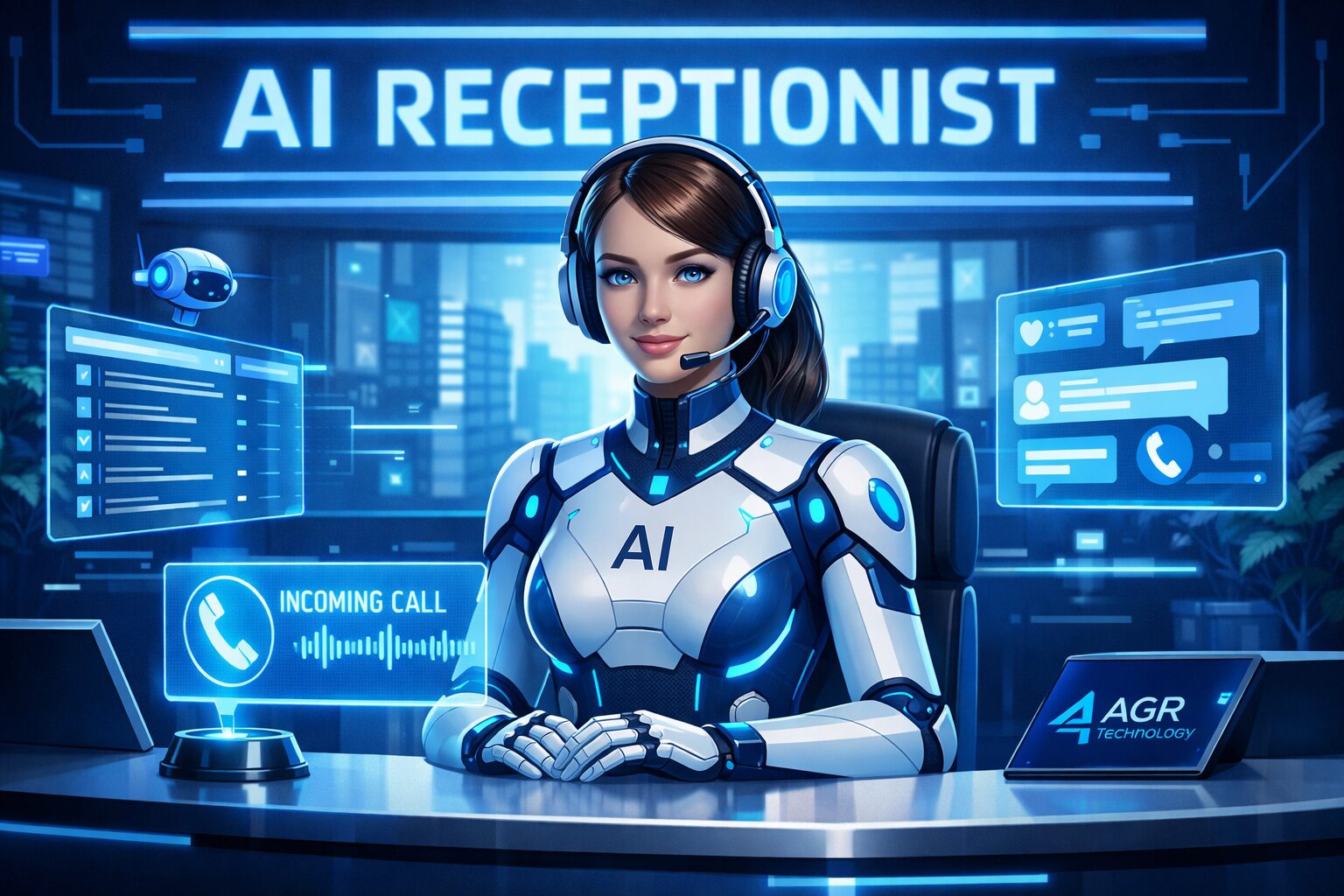
An AI receptionist is a virtual receptionist powered by artificial intelligence that can answer calls, chats, or messages and handle basic front-desk tasks automatically.
Instead of a person sitting at a desk or on a phone line, you have software that can:
- Greet callers or website visitors
- Understand what they’re asking
- Respond with the right information
- Transfer the interaction to a human when needed
You might hear other names for the same concept:
- Virtual receptionist
- AI call answering service
- AI phone agent
- Automated front-desk assistant
The key difference between an AI receptionist and the old-school phone menu (“Press 1 for sales…”) is that an AI receptionist can understand natural language. People can just speak or type like they normally would.
At AGR Technology, we design AI receptionist solutions so your customers don’t need to fight through rigid menus. They ask a question, the system interprets it, and either answers it or routes it correctly.
In short: an AI receptionist is the always-on helper at the front of your business, handling routine interactions so your team can focus on the conversations that actually need a human.
How AI Receptionists Work Behind The Scenes
From the outside, an AI receptionist feels simple: someone calls, talks, gets an answer. Behind the scenes, there’s quite a bit going on.
Core Technologies Powering AI Receptionists
Most AI receptionist systems combine a few key technologies:
- Speech recognition (ASR) – Converts spoken words from the caller into text.
- Natural language understanding (NLU) – Works out what the caller actually wants from that text (for example, “book an appointment next Tuesday”).
- Dialogue management – Decides how the AI should respond and what to ask next.
- Text-to-speech (TTS) – Turns the AI’s response back into natural-sounding speech.
- Integrations and APIs – Connect the AI receptionist to tools you already use, like calendars, CRMs, ticketing systems, or booking platforms.
We focus a lot on configuration and training. The technology is powerful, but it only becomes genuinely useful when it understands your services, your processes, and your preferred way of handling enquiries.
Where AI Receptionists Are Used Today
AI receptionists are no longer experimental: they’re in everyday use across a lot of industries, including:
- Healthcare and allied health – Appointment booking, rescheduling, basic triage questions.
- Legal and professional services – New client intake, call routing, FAQ handling.
- Trades and field services – Capturing job details after-hours, emergency call triage.
- Real estate and property management – Enquiry screening, inspection bookings, rental application questions.
- Hospitality and tourism – Reservation enquiries, opening hours, basic support.
- E-commerce and SaaS – Order status, account questions, password or access guidance.
In many of these cases, our clients use AI receptionists from AGR Technology as a front line for common requests, with human staff handling more complex or sensitive matters.
Under the hood, the setup is tailored to each environment. For example, in healthcare we might connect the AI receptionist to a practice management system, while for a trade business we connect to a job booking or CRM platform.
Common Tasks AI Receptionists Can Handle
AI receptionists are best at repeatable, clearly defined tasks that follow a process. Here are some of the most common ones we carry out for clients.
Call Handling And Phone Routing
An AI receptionist can:
- Answer calls with a friendly branded greeting
- Ask what the caller needs in plain language
- Route calls to the right person or team based on intent
- Share updates like “our team is currently busy, would you like a callback?”
- Take a message with key details if no one is available
This goes beyond a simple phone tree. The caller might say, “I need to change my booking for next week,” and the AI can both understand and act on that, instead of making them guess which number to press.
Scheduling, Reminders, And Calendar Management
If your business runs on appointments or bookings, an AI receptionist can:
- Check availability in your calendar
- Offer time slots and confirm bookings
- Reschedule or cancel appointments under your rules
- Send confirmation and reminder messages
We often integrate our AI receptionist solutions with existing tools like Google Calendar, Microsoft 365, or industry-specific booking systems.
Answering Questions And Sharing Information
Most businesses get the same questions, day in and day out. An AI receptionist can reliably answer things like:
- Opening hours and location
- Pricing ranges and basic service inclusions
- How to get started, what to bring, or what to expect
- Policies on cancellations, payments, or refunds
We help you build a knowledge base so the AI has accurate, approved answers that match how your team would respond.
Intake, Forms, And Lead Capture
AI receptionists are also strong at structured data capture. They can:
- Gather contact details and reason for enquiry
- Ask qualifying questions based on your sales or intake process
- Fill out a digital form or create a record in your CRM
- Tag and prioritise leads based on their responses
This is especially useful for service businesses that can’t afford to miss high-intent enquiries, whether they come in during business hours or at 11pm on a Sunday.
If you’d like to see how this could work for your business, we can walk you through real call flows we’ve implemented through AGR Technology and adapt them to your use case.
Benefits Of Using An AI Receptionist
When AI receptionists are set up properly, they don’t just cut costs: they change how your front-of-house runs.
Cost Savings And 24/7 Availability
With an AI receptionist:
- You can handle far more calls and enquiries without adding headcount.
- You’re covered after-hours, on weekends, and on public holidays.
- You reduce spend on overflow call centres or temp staff.
For many clients we work with, the AI receptionist pays for itself by capturing bookings and leads they previously lost to voicemail or missed calls.
Consistency, Speed, And Reduced Wait Times
AI receptionists don’t get tired or distracted, so:
- Every caller gets a prompt response.
- Information stays consistent, based on your approved scripts and knowledge.
- Simple issues are resolved quickly, instead of sitting in a queue.
That consistency helps with customer experience and with compliance in more regulated industries.
Better Data Capture And Analytics
Because everything runs through software, you gain visibility you might not have had before:
- Call volumes and peak times
- Common questions and friction points
- Conversion rates from enquiry to booking or sale
- Performance of different call flows or scripts
At AGR Technology, we build dashboards so you can see what your AI receptionist is doing, measure impact, and keep refining it.
If you want to cut missed calls, improve response times, and still keep control over how your customers are greeted, an AI receptionist is worth serious consideration.
Limitations And Challenges Of AI Receptionists
AI receptionists are powerful, but they’re not a magic fix for every interaction. It’s important we’re honest about the constraints.
Handling Complex Or Sensitive Interactions
Some conversations should remain with people, not machines. These include:
- Highly emotional or sensitive matters (for example, serious complaints or distress calls)
- Complex problem-solving that requires judgement
- Situations where you must exercise professional discretion
In our deployments, we always design clear escalation paths so the AI receptionist hands over to a human as soon as it detects complexity, confusion, or distress.
Accent, Language, And Accessibility Concerns
While modern speech recognition has come a long way, it isn’t perfect. Challenges can include:
- Strong accents or noisy environments
- Callers switching between languages
- People who prefer not to speak with an automated system
We mitigate this by:
- Choosing voice engines tuned for your main markets
- Offering keypad or web chat options as a fallback
- Making it easy for callers to say “speak to a person” and be transferred
Privacy, Security, And Compliance Considerations
Any system that handles customer information must be treated seriously. With AI receptionists, you need to think about:
- Data storage and location – Where the call data and transcripts are stored.
- Retention policies – How long data is kept.
- Encryption – For calls, messages, and integrations.
- Compliance – Industry standards and local regulations that may apply.
At AGR Technology, we work with you to align the AI receptionist setup with your security policies and legal obligations. If something isn’t appropriate to capture or store, we design around that.
If you’re in a regulated industry and want to understand what’s possible and what’s not, we’re happy to step through it with your team.
Choosing And Implementing An AI Receptionist
There are many AI receptionist tools on the market, and they’re not all equal. The right choice depends on your workflows, volume, and budget.
Clarifying Your Needs And Use Cases
Before you look at platforms, it helps to answer a few questions:
- What types of calls or enquiries cause the most friction today?
- Which tasks are repetitive and follow a clear process?
- What systems do we already use (CRM, booking, ticketing, practice management)?
- When are we missing the most calls – during business hours or after-hours?
- What must always be handled by a human?
We often run short workshops with clients to map these out. That way, the AI receptionist is designed around real problems and not just what the software can technically do.
Key Features To Look For
When you compare AI receptionist solutions, pay close attention to:
- Natural language capability – Does it actually understand free speech, or does it force rigid menu choices?
- Integration options – Can it connect cleanly to your phone system, calendars, CRM, and other tools?
- Customisation – Can greetings, scripts, and workflows be tailored to your brand and processes?
- Analytics and reporting – Will you be able to see performance and tweak over time?
- Escalation controls – How easily can calls be passed to a live agent?
- Support and onboarding – Will you have help configuring and maintaining it?
Our team at AGR Technology focuses on solutions that are configurable rather than one-size-fits-all. We’d rather carry out a slightly simpler setup that fits your processes than a complex one that your team never really adopts.
Best Practices For A Smooth Rollout
Once you’ve chosen a solution, a careful rollout makes all the difference.
We generally recommend:
- Starting with a clear, limited scope – For example, handle after-hours calls and FAQs first.
- Creating and testing scripts with your team – Make sure the tone and information match how you already speak to customers.
- Training staff on when and how to step in – So handovers feel natural.
- Monitoring the first few weeks closely – Listen to sample calls, review transcripts, and refine flows.
- Communicating with customers – Let them know they may interact with an AI receptionist and how to reach a person if they prefer.
If you’d like hands-on help, we can manage the full process for you – from needs analysis and solution design, through to deployment, monitoring, and ongoing optimisation.
Conclusion
AI receptionists are not about replacing your team. They’re about taking the repetitive, process-driven front-desk work off their hands so they can focus on the human conversations that matter.
Used well, an AI receptionist can:
- Answer and route more calls, 24/7
- Reduce wait times and missed enquiries
- Standardise common responses and intake
- Give you better visibility into what customers are asking for
At AGR Technology, we’ve seen small and mid-sized businesses benefit the most: the ones who can’t afford a full-time reception team on every channel, but also can’t afford to keep missing calls or enquiries.
If you’re curious about what an AI receptionist could do in your specific environment, we can:
- Review your current call and enquiry flows
- Identify quick wins for automation
- Show you a tailored demo using real scenarios from your business
Reach out to our team at AGR Technology for a no-obligation chat. We’ll help you work out whether an AI receptionist is the right fit now, what it should handle, and how to roll it out in a way that actually supports your staff and your customers.
Frequently Asked Questions About AI Receptionists
What are AI receptionists and how do they differ from traditional phone menus?
AI receptionists are virtual receptionists powered by artificial intelligence that answer calls, chats, or messages and handle front-desk tasks like routing, bookings, and FAQs. Unlike rigid “Press 1 for sales” menus, they understand natural language, so callers can speak normally and get relevant help or be transferred to a human.
How do AI receptionists work behind the scenes?
AI receptionists typically use speech recognition to convert voice to text, natural language understanding to interpret intent, dialogue management to decide the next step, and text-to-speech to reply. They’re also integrated with tools like calendars, CRMs, and booking systems so they can take actions such as scheduling or capturing leads.
What tasks can an AI receptionist handle for my business?
An AI receptionist can answer and route calls, take messages, manage bookings and calendar changes, send confirmations and reminders, respond to common questions about hours, pricing, and policies, and capture lead or intake details into forms or CRMs. It focuses on repeatable, process-driven tasks so your team handles the complex conversations.
What are the main benefits of using an AI receptionist?
Key benefits include 24/7 coverage without extra headcount, reduced missed calls and voicemails, faster responses, consistent information, and better data on call volumes, common questions, and conversion rates. Many businesses see AI receptionists pay for themselves by capturing bookings and high-intent leads that previously slipped through the cracks.
Are AI receptionists suitable for small businesses and solo operators?
Yes. AI receptionists are often most valuable for small and mid-sized businesses that can’t justify full-time reception staff but still lose opportunities to missed calls. A well-configured system can handle basic enquiries and bookings, act as an after-hours receptionist, and present a professional front without the fixed cost of another employee.
How do I choose the best AI receptionist solution for my needs?
When comparing AI receptionist tools, look for strong natural language capabilities, reliable phone and calendar integrations, customization of greetings and workflows, clear analytics, and easy escalation to human staff. Consider your call volume, peak times, existing software stack, and which interactions must always go to a person before deciding.
More content:
AI Receptionists For Electricians
AI Receptionists for Small Business
AI Chatbot Development Services

Alessio Rigoli is the founder of AGR Technology and got his start working in the IT space originally in Education and then in the private sector helping businesses in various industries. Alessio maintains the blog and is interested in a number of different topics emerging and current such as Digital marketing, Software development, Cryptocurrency/Blockchain, Cyber security, Linux and more.
Alessio Rigoli, AGR Technology