![logo-new-23[1]](https://agrtech.com.au/wp-content/uploads/elementor/thumbs/logo-new-231-qad2sqbr9f0wlvza81xod18hkirbk9apc0elfhpco4.png "logo-new-23[1]")
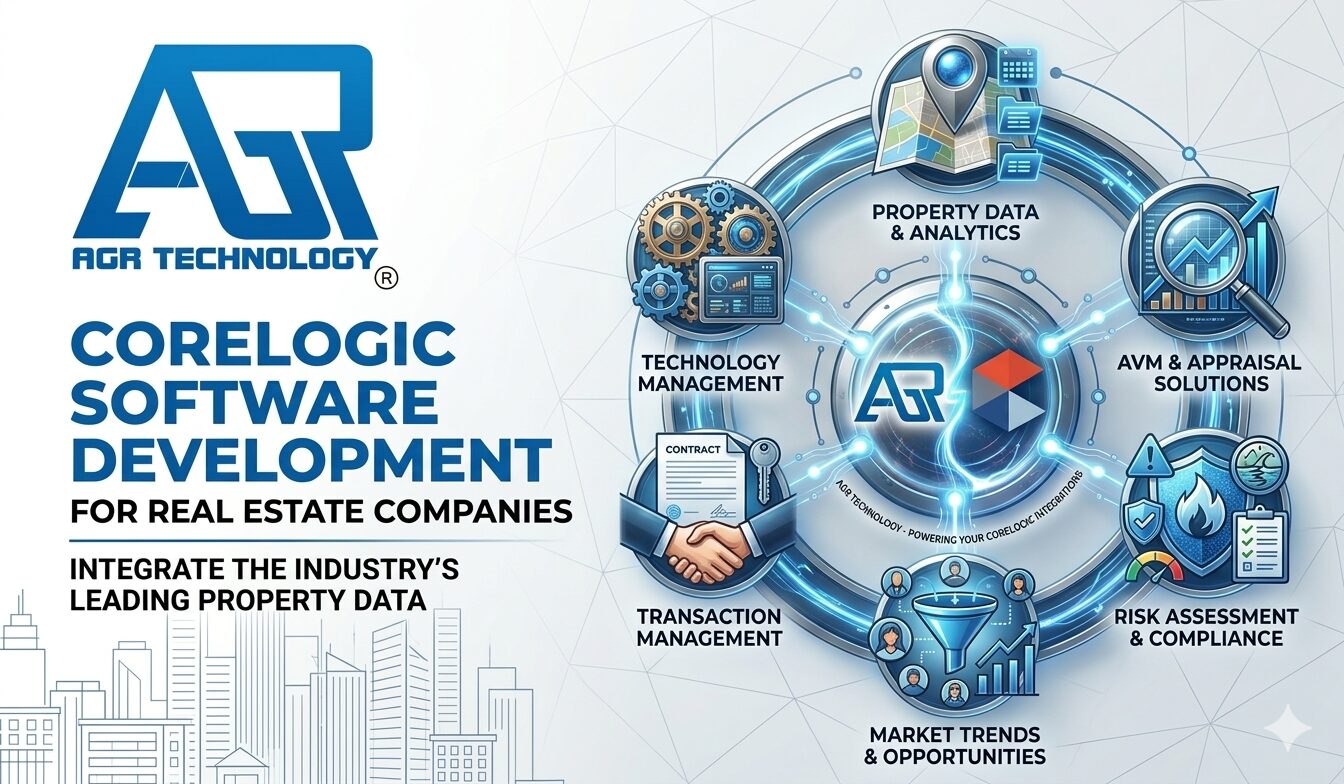
Property data now sits at the centre of modern real estate platforms. From valuation tools and suburb analytics dashboards to lender workflows and investor portals, the quality of the software often matters just as much as the quality of the data itself. That’s where CoreLogic Software Development becomes valuable.
CoreLogic, now also operating under the brand Cotality, provides widely used property data and analytics across ownership records, sales history, valuation models, market insights, and related risk datasets. But raw access to data rarely creates business value on its own. Real estate companies usually need custom applications, integrations, dashboards, and automated workflows to turn that information into something practical.
At AGR Technology, we help businesses build those systems. As an Australian digital solutions provider, we work across custom software development, API integrations, SaaS products, digital infrastructure, enterprise systems, and data-driven platforms. For real estate companies, that means designing software that connects CoreLogic and Cotality data with internal tools, customer-facing platforms, and property analytics software that supports faster decisions and better user experiences.
Get in contact with us to discuss your project
What our clients are saying

Justine Brummans
Alessio is both incredibly knowledgeable and personable! He gave me great advice that was catered to me and my situation. Thank you Alessio! Super helpful!

Springfield Equestrian Park
Alessio is amazing! I can not speak highly enough of how helpful and knowledgeable he is, my website he created far exceeded my expectations, he is so accomodating and I can only wish him every success with his business. I rate AGR technology 10 out of 10.
Legacy Energy
We used AGR Technology and dealt with Alessio to design and build our website as well as host our emails. Alessio was a pleasure to deal with and had plenty of ideas that we could implement into our site. He has a great attention to detail, he is also very polite in understanding our goals and what we wanted to achieve with our website.
Thanks mate,
Alex & Rob
Excellent Service
Alessio developed our website for our business and has done a wonderful job. He is very personable and knowledgeable. We have enjoyed working with him. We will be referring others to him and highly recommend him to those who need Tech advice.
MRC Performance
I have been in business for over 10 Years and recently moved to AGR Technology for all our IT needs. They are able to fix nearly anything remotely and always very helpful in recommending appropriate hardware upgrades that do the job as required but not costing more than needed.

Alessio provided an excellent service. He was very dedicated in his method of finding solutions to problems. He continued to try different avenues until he found the reason as to why a particular application was not working. He was very knowledgeable in his understanding of the internet and of applications and how they work, and he was able to apply this knowledge in understanding how to resolve the obstacles that continued to appear. He is understanding towards his client's needs and goals and he is willing to work with his client in achieving those goals. He is a very polite and well mannered person and very calm and gentle in his approach. I would highly recommend Alessio's services to anyone.

Palmira Rigoli
Great work ethics Alessio! We at Totally Gluten Free Products are very happy to have you on board as our IT and SEO master. Very reliable, trustworthy and knowledgeable in the field.
YouTube Comment
Nat's Custom Designs
Alessio from AGR Technology has recently helped me create a website for my business.
Throughout the whole process from start to finish Alessio made the process easy for me, by calling me and explaining each step of the way. I'm not very computer savvy, but with Alessio taking the time to explain in detail everything I needed to know from putting inventory in to having it shipped. He even remotely joined my computer to help guide me through everything.
He's very knowledgeable and is experienced in everything I needed and if there was anything else I needed to know that wasn't something he was familiar with, he researched it.
I would HIGHLY recommend Alessio to anyone. He has not only helped me for now but I know that if I ever needed help with anything else he would definitely go above and beyond to help. Thank you so much for everything you have done. It's been a long process but well worth it 🙂
Byron Macumber
AGR Technology is amazing. not only do they stick with you through out the process, they also accommodate to your wants and needs. They are efficient in their work and they have high integrity. Their capabilities are shown through their website design, and appropriate knowledge of utilities regarding software. over the many years of working with them they have been fantastic. I would recommend to everyone
Very helpful
Alessio was thorough, diligent and kept me updated at all time points. I was very impressed with his performance, passion and dedication. I will continue to use his services.
Wantrup & Associates
Alessio of AGR Technology is an IT guy we rely on whenever we need IT help. His professionalism impressed us right at the first time. He solved many of our IT problems in no time. Excellent communication and speedy response.
We highly recommend this company
From a happy customer
Valeria Bianco
I received AGR contact information from a previous client, who had found their service excellent. So I contacted AGR with some expectations, and I can say they exceeded them. Professional, honest, punctual, reliable, their service is faultless. We can't recommend them highly enough.
Very fast, value for money and a comprehensive service
AGR is professional, organised and very skilled at what they do. They take the initiative, looking after all the details that you would not have thought of to enhance your website presence, marketing funnel and automated appointment bookings. Big bonus - pricings are at a fraction of the cost of competitors.
Customer testimonial
Alessio from AGR Technology is wonderful at gently guiding the less technically savvy users to solve problems. Back up service excellent. Highly recommended
SEO for website
The team is very cooperative and delivers clean and very efficient work.

Raimond Volpe
Nothing but good things to say about Alessio. He has been great service and great at communicating with me by both phone and email. Very good knowledge and problem-solving ability with our web development. I would thoroughly recommend Alessio and AGR Technology to anyone wanting online marketing or web development
Website design
Big thank you to Alessio at AGR Technology for a smooth and easy website development process. Nothing was to difficult to accomplish, I can highly recommend his first class service.
Proudly supporting clients of all sizes to succeed through digital solutions













Why work with us?





What CoreLogic Software Development Means In Real Estate

When we talk about CoreLogic Software Development, we’re talking about building software that uses CoreLogic data services in a purposeful way for real estate operations, products, and decision-making.
CoreLogic is a global property data and analytics provider, and Cotality is its newer brand identity. Many businesses still search for CoreLogic, while others are beginning to use Cotality, so it’s important to understand they refer to the same data ecosystem and broader platform transition.
In practical terms, this development work can involve:
- Integrating property ownership records into internal systems
- Connecting sales history and suburb-level market trends to research tools
- Using automated valuation models in finance or investment workflows
- Powering insurance and risk modelling interfaces
- Building custom real estate software development solutions around property intelligence
These datasets are widely used across real estate, lending, insurance, and proptech software development because they provide the context businesses need to evaluate assets, monitor markets, and automate decisions.
But data access alone is not the end goal. Most organisations need tailored software that fits their process, whether that’s a client portal, mobile app, analytics dashboard, CRM integration, or a complete proptech platform development project. That is where custom engineering matters. We help turn enterprise-grade property data into software people can actually use, whether the objective is operational efficiency, better reporting, or a new revenue-generating product.
Common Use Cases For Custom CoreLogic Integrations

Real estate companies rarely use property data in just one place. More often, they need it pulled into multiple systems, standardised, enriched, and presented in a way that supports staff, clients, or partners. Strong CoreLogic API integration work makes that possible.
Property Data Aggregation And Enrichment
A common use case is combining CoreLogic or Cotality data with internal records or third-party sources to create richer property profiles. This might include ownership information, valuation estimates, sales history, listing details, zoning context, or local market movements.
For example, a business may want to enrich a property search platform with suburb insights and comparative sales data, or build a property data software development solution that gives investors a clearer picture of yield, growth trends, and comparable transactions. Done well, this kind of real estate data API integration turns separate data points into something far more useful.
CRM, ERP, And Workflow Automation
Property businesses also use CoreLogic-connected systems to reduce manual admin. We often see demand for integrations that push data into CRMs, ERPs, finance systems, or internal workflow tools.
That can include:
- Creating records automatically when an address is matched
- Populating customer or asset profiles with property intelligence
- Triggering valuation checks during loan or appraisal workflows
- Synchronising property data across departments
This is particularly useful for agencies, mortgage groups, and enterprise property businesses that want cleaner data and less duplication. It also supports more efficient custom real estate software development by ensuring the underlying systems talk to each other.
Valuation, Risk, And Reporting Solutions
Another major category is analytical software. Businesses use CoreLogic datasets to build valuation tools, lending support systems, insurance risk interfaces, and portfolio reporting platforms.
Examples include:
- Automated property valuation tools
- Mortgage assessment dashboards
- Insurance exposure analysis systems
- Market performance reporting portals
- Property portfolio management applications
These systems help organisations move faster without relying on spreadsheets and manual data gathering. In many cases, they become the core of a broader property analytics software offering or a subscription-based proptech product.
Key Features Of Effective CoreLogic-Connected Software

Not all integrations are equal. A basic connection to a data source is one thing: a reliable, secure, and scalable platform is something else entirely. Effective CoreLogic integration services should be designed around both technical performance and business usability.
API Integrations And Data Synchronization
At the foundation is the API layer. Software needs to retrieve, validate, transform, and synchronise data accurately. Depending on the use case, that may involve pulling property profiles, valuation estimates, sales history, suburb trends, or listing-related analytics into internal systems or customer-facing platforms.
Good integration design usually includes:
- Stable API connection handling
- Data mapping and normalisation
- Scheduled syncs or event-based updates
- Caching for performance
- Error handling and monitoring
This matters because property data is only useful if it is consistent and available where people need it. Reliable CoreLogic API integration helps prevent data silos and reduces the friction between platforms.
Security, Compliance, And Access Control
Real estate and financial systems often involve sensitive information, commercial restrictions, and licensing obligations. That means security cannot be treated as an afterthought.
We typically recommend role-based permissions, secure authentication, encrypted data flows, and audit visibility across core actions. Access also needs to reflect licensing and contractual requirements tied to property datasets. In some projects, businesses need different levels of access for brokers, analysts, agents, administrators, or end users.
For any serious property data software development project, security architecture should be built into the system from day one, not patched in later.
Scalable Architecture For Web And Mobile Platforms
A lot of proptech ideas start small and then grow quickly. Maybe it begins as an internal dashboard. Then it becomes a client portal. Then a mobile product. Then a multi-tenant SaaS platform.
That growth path is exactly why architecture matters. Effective software should support:
- Web and mobile delivery
- Modular services and future integrations
- High-volume data processing
- Fast search and reporting experiences
- Cloud infrastructure that can scale with demand
This is especially important in proptech platform development, where speed, usability, and future extensibility often determine whether a platform remains useful after launch.
Challenges Real Estate Businesses Face With CoreLogic Development
On paper, property data integration can sound straightforward. In practice, it often isn’t.
One of the first issues businesses run into is complexity in enterprise APIs and documentation. Data structures may be broad, field mapping can be nuanced, and the ideal implementation depends heavily on the workflow being supported. A team might know the data they want, but not the cleanest way to operationalise it.
Then there’s data normalisation. Property information often needs to be cleaned, matched, transformed, and reconciled with existing systems before it becomes useful. Address formatting, duplicate entities, inconsistent field naming, and timing differences between systems can all create friction.
Performance is another challenge. Large datasets, repeated lookups, and analytics-heavy applications can put real pressure on infrastructure if the system isn’t designed well. The same goes for availability and resilience. If a customer-facing platform depends on external data sources, the software has to manage failures gracefully.
There are also licensing and compliance considerations. Businesses need to understand what data can be stored, displayed, shared, or repurposed within their specific agreement. That’s not just legal housekeeping: it directly affects software architecture and access design.
This is why experienced engineers matter. In CoreLogic Software Development, success usually depends on more than coding alone. It requires thoughtful system design, practical knowledge of integrations, and a clear understanding of how property technology platforms actually operate in the real world.
How To Plan A CoreLogic Software Development Project
The best projects usually begin with a clear business case, not a feature list. Before building anything, we work backwards from outcomes: what the platform needs to do, who will use it, what systems it must connect with, and what commercial value it should create.
Defining Business Goals And System Requirements
A real estate company might want to launch a client-facing analytics portal, automate lender workflows, enrich listings, or create a new SaaS product using property intelligence. Each goal leads to different technical priorities.
At this stage, it helps to define:
- Target users and user roles
- Required CoreLogic or Cotality datasets
- Integration points with existing systems
- Reporting, analytics, or automation needs
- Security, hosting, and compliance requirements
This early planning reduces rework and makes later development decisions much easier.
Choosing Between Custom Builds And Connected Platforms
Some businesses need a fully bespoke platform. Others are better served by integrating CoreLogic data into an existing CRM, ERP, portal, or workflow environment. The right choice depends on budget, timeline, internal systems, and long-term product ambitions.
A custom build is often the better fit when you need differentiated functionality, unique workflows, or a platform that may evolve into a commercial software product. On the other hand, a connected solution can work well if the goal is to improve operations without rebuilding the entire stack.
As part of our CoreLogic integration services, we help clients assess both paths realistically. Sometimes the answer is a standalone proptech solution. Sometimes it’s a staged rollout that starts with key integrations and expands over time.
Testing, Deployment, And Ongoing Support
Once the build approach is clear, execution matters. Property platforms need proper testing across data accuracy, sync logic, permissions, reliability, and user workflows. It’s not enough for the API call to work once: the full experience has to hold up under real conditions.
Deployment should also consider environment configuration, monitoring, rollback planning, and future updates. And after launch, support matters just as much as development. APIs evolve, datasets expand, user expectations change, and software needs maintenance to stay useful.
For that reason, we treat CoreLogic Software Development as an ongoing capability rather than a one-off build. The strongest systems are maintained, improved, and aligned with business growth over time.
Conclusion
For real estate companies, property data can be a real competitive asset, but only when it’s implemented properly. CoreLogic Software Development is really about turning valuable datasets into usable business systems: portals, dashboards, valuation tools, workflow automations, and scalable proptech products.
Because CoreLogic now operates under the Cotality brand, businesses searching for either name are eventually looking for the same thing: a reliable way to integrate trusted property intelligence into modern digital platforms.
At AGR Technology, we build custom software, integrations, SaaS applications, and data-driven infrastructure that help organisations make better use of property data. Whether you need property analytics software, custom real estate software development, or a broader proptech software development partner, we can help scope, build, and support the right solution.
If your business is planning a property platform, needs real estate data API integration, or wants expert support with CoreLogic integration services, contact AGR Technology to discuss your project.
Frequently Asked Questions
What is CoreLogic software development in real estate?
CoreLogic software development means building custom software that uses CoreLogic, now also branded as Cotality, data inside real estate, lending, insurance, or proptech platforms. This can include dashboards, portals, valuation tools, workflow automations, and integrations that turn property data into practical business systems.
Is CoreLogic the same as Cotality?
Yes. CoreLogic now operates under the Cotality brand, so both names refer to the same broader property data and analytics ecosystem. Many businesses still search for CoreLogic software development, while others use Cotality, but they are generally looking for the same integration and platform capabilities.
How is CoreLogic API integration used in custom real estate software development?
CoreLogic API integration is commonly used to pull property ownership records, sales history, valuation estimates, and suburb insights into CRMs, portals, ERPs, and analytics tools. In custom real estate software development, this helps businesses automate workflows, enrich property profiles, and give users faster access to reliable property intelligence.
What features should effective CoreLogic-connected software include?
Effective CoreLogic-connected software should include stable API handling, data mapping, synchronization, caching, monitoring, and strong error handling. It also needs security features such as role-based access, encrypted data flows, and scalable architecture for web or mobile delivery so the platform remains reliable as usage grows.
What challenges can happen during CoreLogic software development projects?
Common challenges include complex APIs, data normalization issues, address matching problems, performance pressure from large datasets, and compliance restrictions around how property data can be stored or displayed. Successful CoreLogic software development usually requires careful system design, resilient infrastructure, and a clear understanding of licensing obligations.
How long does it take to build a CoreLogic-integrated platform?
The timeline depends on scope, integrations, and whether you are enhancing an existing system or creating a custom platform from scratch. A simple workflow integration may take weeks, while a larger SaaS or analytics platform can take months. Clear requirements, testing, and staged delivery usually improve speed and reduce risk.
Related content:
Software Development Solutions By AGR Technology
Property Developer Software Solutions
IT Services for Highrise Buildings
Google Ads For Real Estate Agents
IT Services for Commercial Buildings & Realestate Buildings
Real Estate Reputation Management Services
SaaS (Software-As-A-Service) Development

Alessio Rigoli is the founder of AGR Technology and got his start working in the IT space originally in Education and then in the private sector helping businesses in various industries. Alessio maintains the blog and is interested in a number of different topics emerging and current such as Digital marketing, Software development, Cryptocurrency/Blockchain, Cyber security, Linux and more.
Alessio Rigoli, AGR Technology