![logo-new-23[1]](https://cdn-ihdfn.nitrocdn.com/eZVJvoSTyVixkEUySRKiaseNtUlmgCyu/assets/images/optimized/rev-b7ced37/agrtech.com.au/wp-content/uploads/elementor/thumbs/logo-new-231-qad2sqbr9f0wlvza81xod18hkirbk9apc0elfhpco4.png "logo-new-23[1]")
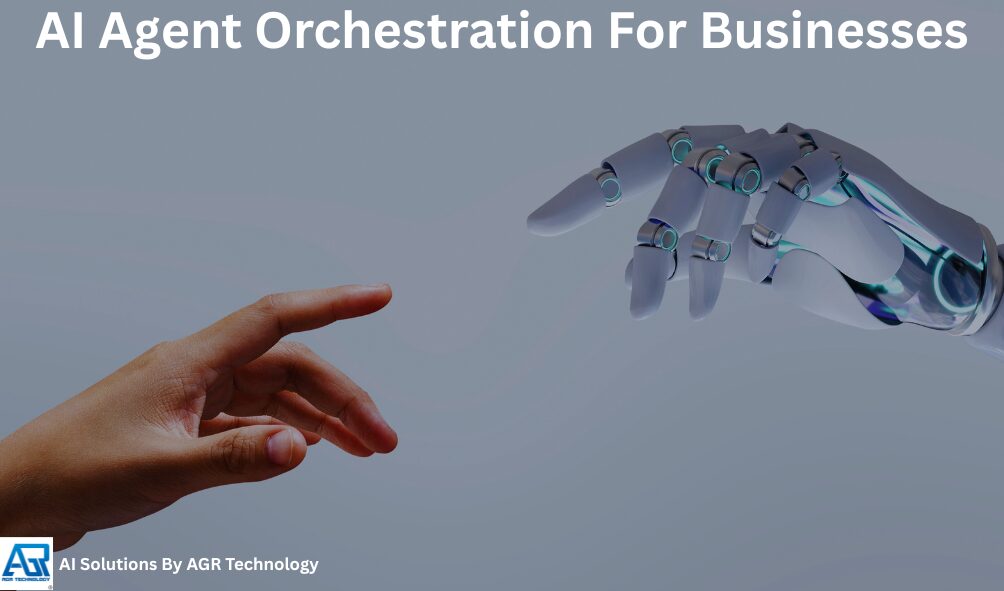
If your team is still relying on disconnected automations, manual handoffs, or one-off AI prompts, there’s a ceiling on how much value you’ll get. At some point, the problem is no longer access to AI models. It’s getting multiple AI agents, business rules, systems, and people to work together without creating chaos.
That’s where AI agent orchestration comes in.
For businesses looking to streamline operations, improve response times, and reduce repetitive admin, multi-agent systems can handle meaningful work in the background, including after-hours. But they only work well when the orchestration layer is designed properly. Without that layer, even strong models can fail in messy, expensive, and sometimes risky ways.
In this guide, we’ll explain what AI agent orchestration actually means, where it creates real business value, what a reliable setup needs, and how to start without overbuilding. At AGR Technology, we help businesses plan and carry out practical AI automation solutions that fit real workflows, not just demos that look impressive for five minutes.
Get in contact with us now:
Reviews from our happy clients:

Justine Brummans
Alessio is both incredibly knowledgeable and personable! He gave me great advice that was catered to me and my situation. Thank you Alessio! Super helpful!

Springfield Equestrian Park
Alessio is amazing! I can not speak highly enough of how helpful and knowledgeable he is, my website he created far exceeded my expectations, he is so accomodating and I can only wish him every success with his business. I rate AGR technology 10 out of 10.
Legacy Energy
We used AGR Technology and dealt with Alessio to design and build our website as well as host our emails. Alessio was a pleasure to deal with and had plenty of ideas that we could implement into our site. He has a great attention to detail, he is also very polite in understanding our goals and what we wanted to achieve with our website.
Thanks mate,
Alex & Rob
Excellent Service
Alessio developed our website for our business and has done a wonderful job. He is very personable and knowledgeable. We have enjoyed working with him. We will be referring others to him and highly recommend him to those who need Tech advice.
MRC Performance
I have been in business for over 10 Years and recently moved to AGR Technology for all our IT needs. They are able to fix nearly anything remotely and always very helpful in recommending appropriate hardware upgrades that do the job as required but not costing more than needed.

Alessio provided an excellent service. He was very dedicated in his method of finding solutions to problems. He continued to try different avenues until he found the reason as to why a particular application was not working. He was very knowledgeable in his understanding of the internet and of applications and how they work, and he was able to apply this knowledge in understanding how to resolve the obstacles that continued to appear. He is understanding towards his client's needs and goals and he is willing to work with his client in achieving those goals. He is a very polite and well mannered person and very calm and gentle in his approach. I would highly recommend Alessio's services to anyone.

Palmira Rigoli
Great work ethics Alessio! We at Totally Gluten Free Products are very happy to have you on board as our IT and SEO master. Very reliable, trustworthy and knowledgeable in the field.
YouTube Comment

Nat's Custom Designs
Alessio from AGR Technology has recently helped me create a website for my business.
Throughout the whole process from start to finish Alessio made the process easy for me, by calling me and explaining each step of the way. I'm not very computer savvy, but with Alessio taking the time to explain in detail everything I needed to know from putting inventory in to having it shipped. He even remotely joined my computer to help guide me through everything.
He's very knowledgeable and is experienced in everything I needed and if there was anything else I needed to know that wasn't something he was familiar with, he researched it.
I would HIGHLY recommend Alessio to anyone. He has not only helped me for now but I know that if I ever needed help with anything else he would definitely go above and beyond to help. Thank you so much for everything you have done. It's been a long process but well worth it 🙂
Byron Macumber
AGR Technology is amazing. not only do they stick with you through out the process, they also accommodate to your wants and needs. They are efficient in their work and they have high integrity. Their capabilities are shown through their website design, and appropriate knowledge of utilities regarding software. over the many years of working with them they have been fantastic. I would recommend to everyone
Very helpful
Alessio was thorough, diligent and kept me updated at all time points. I was very impressed with his performance, passion and dedication. I will continue to use his services.
Wantrup & Associates
Alessio of AGR Technology is an IT guy we rely on whenever we need IT help. His professionalism impressed us right at the first time. He solved many of our IT problems in no time. Excellent communication and speedy response.
We highly recommend this company
From a happy customer
Valeria Bianco
I received AGR contact information from a previous client, who had found their service excellent. So I contacted AGR with some expectations, and I can say they exceeded them. Professional, honest, punctual, reliable, their service is faultless. We can't recommend them highly enough.
Very fast, value for money and a comprehensive service
AGR is professional, organised and very skilled at what they do. They take the initiative, looking after all the details that you would not have thought of to enhance your website presence, marketing funnel and automated appointment bookings. Big bonus - pricings are at a fraction of the cost of competitors.
Customer testimonial
Alessio from AGR Technology is wonderful at gently guiding the less technically savvy users to solve problems. Back up service excellent. Highly recommended
SEO for website
The team is very cooperative and delivers clean and very efficient work.

Raimond Volpe
Nothing but good things to say about Alessio. He has been great service and great at communicating with me by both phone and email. Very good knowledge and problem-solving ability with our web development. I would thoroughly recommend Alessio and AGR Technology to anyone wanting online marketing or web development
Website design
Big thank you to Alessio at AGR Technology for a smooth and easy website development process. Nothing was to difficult to accomplish, I can highly recommend his first class service.
Proudly supporting clients of all sizes to succeed through digital solutions










Why work with us?






What AI Agent Orchestration Actually Means

AI agent orchestration is the process of coordinating multiple AI agents, tools, workflows, and decision rules so work gets completed in the right order, by the right system, with the right controls.
In plain terms, orchestration is what turns scattered AI capabilities into an operational system.
A lot of businesses first encounter AI through a chatbot, a content tool, or a single assistant connected to a knowledge base. That can be useful. But once the goal shifts from “answer one question” to “complete a business process”, a single agent usually isn’t enough. You need different agents or services to handle planning, retrieval, reasoning, task execution, validation, and escalation.
That’s why orchestration matters. It manages:
- Which agent does what
- When a workflow starts
- How information is passed between steps
- When a human needs to approve something
- What happens when an agent fails or returns a weak output
- How activity is logged for monitoring and compliance
Single-Agent Vs Multi-Agent Systems
A single-agent system typically uses one AI assistant to complete a task from start to finish. That can work for simple use cases such as:
- Drafting a first-pass email
- Summarising a document
- Answering basic internal questions
- Classifying straightforward support tickets
A multi-agent system splits work across specialised agents or components. For example:
- One agent reviews incoming enquiries
- Another pulls relevant CRM or ERP data
- Another drafts the response or next-step action
- Another checks policy compliance or brand tone
- Final step that routes the outcome to a human or publishes it automatically
This structure is often more reliable because each part has a narrower role. Instead of asking one model to do everything well, we assign clear responsibilities.
Why Orchestration Matters More Than Model Power
Businesses often focus on which model is “best”. That matters, but not as much as people think.
In production environments, the bigger issue is usually workflow design. A highly capable model can still produce poor outcomes if:
- It gets incomplete context
- It has access to the wrong tools
- It makes a decision that should require approval
- It passes bad data to the next step
- Nobody notices failures until customers complain
A well-orchestrated multi-agent system can outperform a more powerful but poorly managed setup because it creates structure. It adds checkpoints, context control, fallback logic, and accountability.
That’s the difference between an AI demo and an AI system a business can actually trust.
Where Multi-Agent Systems Create Real Business Value
The strongest use cases for AI agent orchestration are usually not flashy. They’re operational. They save time, reduce lag, improve consistency, and free up staff for higher-value work.
For small and enterprise businesses alike, the value often comes from connecting existing platforms and processes rather than replacing everything.
Common Use Cases Across Operations, Marketing, And Customer Support
Here are a few common ways multi-agent systems create practical business value:
Operations
- Processing internal requests across departments
- Extracting and validating data from forms, emails, or PDFs
- Routing tasks based on urgency, department, or business rules
- Generating summaries for leadership or project teams
- Maintaining after-hours workflow continuity
Marketing
- Researching topics and competitors
- Building content briefs from SERP trends and internal data
- Drafting campaign assets for review
- Tagging and organising leads by intent or behaviour
- Monitoring campaign performance and flagging anomalies
Customer support
- Triaging tickets before they reach staff
- Identifying account history and context from integrated systems
- Drafting help responses using approved knowledge sources
- Escalating high-risk or sensitive matters to humans
- Handling common after-hours enquiries while logging everything properly
For example, a service-based business might use a multi-agent workflow where one agent classifies leads, another enriches business data, another drafts a follow-up, and another schedules the next step in the CRM. That saves time without removing oversight.
When A Multi-Agent Setup Is Better Than A Simple Automation
Not every workflow needs multiple agents.
If a process is linear, rule-based, and predictable, standard automation may be enough. A simple trigger-action flow can often handle:
- Appointment reminders
- Invoice notifications
- Form confirmations
- Basic lead routing
A multi-agent setup becomes more useful when the workflow includes one or more of the following:
- Unstructured inputs such as emails, voice notes, or long documents
- Multiple systems that need to be queried or updated
- Conditional reasoning or exceptions
- Quality checks before execution
- Human review points
- Changing business logic over time
A good rule of thumb: if the work requires judgment, context assembly, tool use, and verification, orchestration is probably more important than a basic automation builder.
This is where businesses often need technical guidance. At AGR Technology, we help organisations identify where AI workflow automation can genuinely reduce friction and where a simpler approach is smarter. Not everything needs an agent swarm. Some things just need a cleaner process.
The Core Building Blocks Of A Reliable Orchestration Layer
A reliable orchestration layer is what makes AI automation usable in the real world. Without it, you may get outputs, but not dependable business outcomes.
The exact architecture varies, but strong multi-agent systems usually include the same foundational components.
Roles, Rules, Memory, And Tool Access
Each agent should have a clearly defined role.
That sounds obvious, but it’s where many projects go wrong. If every agent has broad instructions and overlapping responsibilities, errors multiply fast. We prefer to keep agents narrow and specific.
Core building blocks include:
- Roles: what each agent is responsible for
- Rules: what it can and cannot do
- Memory: what context is retained across tasks or sessions
- Tool access: which systems, APIs, databases, or apps it can use
For example, a research agent may be able to retrieve data, but not publish updates. A customer support drafting agent may suggest a reply, but not send it without approval. An operations agent may update a project management tool but not modify billing data.
This matters for both performance and risk control.
Triggers, Handoffs, And Human Approval Points
Multi-agent workflows also need clear orchestration events.
That includes:
- Triggers: what starts the process, such as a new lead, a support ticket, or a missed payment
- Handoffs: how work moves from one agent or system to the next
- Approval points: where a person reviews, edits, or approves a decision before it proceeds
A practical orchestration layer should answer questions like:
- What happens if an agent cannot complete a task?
- What if confidence is low?
- What if data is missing or contradictory?
- Which actions are safe to automate fully?
- Which actions must always be reviewed by staff?
Those are not edge cases. They’re normal operating conditions.
If your business is designing AI agents for customer service, internal operations, or marketing workflows, these controls are what separate scalable implementation from expensive trial and error.
How To Design Multi-Agent Workflows That Do Not Break At Scale
It’s easy to make a workflow work once. It’s much harder to make it work repeatedly across messy inputs, growing volumes, and changing business needs.
That’s why scalable AI orchestration starts small and gets stricter as it expands.
Start With Narrow Tasks And Clear Success Metrics
The best place to start is a narrow workflow with measurable value.
Good first candidates usually have:
- High repetition
- Clear inputs and outputs
- Existing process pain points
- Manageable risk
- Visible time or cost savings
Examples include:
- Lead qualification
- Support ticket triage
- Content brief generation
- Internal request routing
- Document intake and extraction
Before building, define success properly. Not vaguely, specifically.
Useful metrics may include:
- Turnaround time
- Accuracy rate
- Manual hours saved
- First-response speed
- Escalation rate
- Cost per completed task
When those benchmarks are clear, it becomes easier to evaluate whether the orchestration layer is doing its job.
Reduce Failure Risks With Guardrails And Observability
As workflows scale, failures become harder to spot manually. So observability is essential.
That means you need visibility into:
- Which agent acted
- What input it received
- What output it generated
- What tool it used
- Where the workflow slowed down or failed
- When a human intervened
Guardrails are just as important. Common examples include:
- Confidence thresholds before action is taken
- Output validation rules
- Restricted tool permissions
- Retry logic with limits
- Fallback routing to a human team member
- Audit logs for traceability
Without guardrails, a broken workflow can quietly create bad records, weak communications, or compliance issues at scale. And that’s usually when businesses decide AI “doesn’t work”, when the real issue was orchestration design.
If you’re planning AI deployment across multiple teams, this is where working with an experienced implementation partner can help. AGR Technology supports businesses with custom software, workflow automation, and AI integration strategies that are built for operational reliability, not just speed.
Security, Governance, And Compliance Considerations
AI agent orchestration should never be treated as just a productivity experiment. Once agents interact with customer data, internal systems, or operational decisions, governance matters.
Key considerations include:
- Access control: agents should only access the systems and data they genuinely need
- Data handling: sensitive information should be stored, transmitted, and processed securely
- Auditability: actions should be logged for review and accountability
- Approval policies: high-risk actions should require human sign-off
- Vendor review: third-party tools and models should be evaluated for privacy, reliability, and contractual fit
- Compliance alignment: workflows should reflect industry-specific obligations where relevant
For Australian businesses especially, privacy, recordkeeping, and security expectations are becoming harder to ignore, even when solutions are deployed globally.
A practical question we often ask is simple: If this workflow made a wrong decision tomorrow, could your team trace what happened and stop it quickly?
If the answer is no, the system needs more governance before scaling.
This is particularly important in sectors handling customer records, financial data, health-related information, legal workflows, or regulated communications. Even outside regulated industries, reputational risk is enough reason to be careful.
Good governance does not need to slow innovation down. But it does need to be built in from the start.
How To Get Started Without Overengineering
The fastest way to stall an AI project is to design for every possible future scenario before solving one real problem.
Most businesses get better results by starting with a focused workflow, proving value, and then expanding deliberately.
Choose One High-Value Workflow First
Start with a workflow that is:
- Repetitive
- Time-consuming
- Painful for staff
- Important enough to matter
- Safe enough to test with controls in place
For many businesses, that could be:
- Inbound lead qualification
- Support queue triage
- Proposal preparation support
- Recurring reporting
- After-hours enquiry handling
This gives you something measurable and useful without forcing a full transformation project on day one.
Measure Cost, Speed, Accuracy, And Business Impact
Once the workflow is live, review performance like you would any other business system.
Track:
- Cost: total tool, usage, and implementation cost
- Speed: how quickly tasks move from input to outcome
- Accuracy: whether outputs are correct and usable
- Business impact: time saved, conversion lift, service improvement, or reduction in manual load
If a workflow saves ten minutes but creates review headaches, it’s not a win. If it reduces response times, improves consistency, and frees your team for higher-value work, that’s different.
Businesses that get long-term value from AI orchestration tend to treat it as an operational capability, not a novelty.
If you’re exploring AI automation services, custom integrations, or multi-agent workflow design, AGR Technology can help map the right starting point. We focus on practical implementations that align with your systems, risk profile, and growth goals. If you’d like to discuss a use case, contact our team for a straightforward conversation.
Conclusion
AI agent orchestration is not about adding more AI for the sake of it. It’s about designing systems that can coordinate work reliably, safely, and efficiently across real business processes.
The businesses seeing the best results in 2026 are not necessarily the ones using the most advanced models. They’re the ones building structured multi-agent systems with clear roles, strong controls, useful integrations, and measurable outcomes.
If you want AI systems that keep work moving while your team sleeps, the priority is not just intelligence. It’s orchestration.
And if you need a partner to help plan, build, or refine that setup, AGR Technology can help you move from scattered automation to reliable execution. Get in touch to discuss a practical next step for your business.
AI Agent Orchestration FAQs
What is AI agent orchestration and why is it important for businesses?
AI agent orchestration coordinates multiple AI agents, workflows, and decision rules to complete business processes reliably and efficiently. It transforms scattered AI capabilities into operational systems that reduce bottlenecks and improve outcome consistency.
How do multi-agent AI systems differ from single-agent systems?
Single-agent systems use one AI model to handle a task end-to-end, suitable for simple jobs like drafting emails. Multi-agent systems split tasks among specialized agents, improving reliability by assigning clear roles like data retrieval, drafting, and compliance checks.
When should a business use multi-agent systems instead of simple automation?
Multi-agent systems are best when workflows involve unstructured inputs, multiple systems, conditional logic, quality checks, or human approvals. Simpler automations suffice for linear, predictable tasks like appointment reminders or invoice notifications.
What are key components needed for a reliable AI agent orchestration layer?
A reliable orchestration layer needs clearly defined agent roles, strict business rules, memory for context retention, controlled tool access, workflow triggers, handoffs, approval points, and robust failure handling mechanisms.
How does AI agent orchestration enhance operational workflows in marketing and customer support?
In marketing, orchestration helps research, content creation, lead tagging, and campaign monitoring. In customer support, it triages tickets, integrates account history, drafts responses, escalates issues, and manages after-hours inquiries effectively.
What governance and compliance considerations are essential for AI agent orchestration?
Governance includes access control to data and systems, secure data handling, auditability of AI actions, human approval for high-risk tasks, vendor evaluation, and alignment with industry-specific privacy and compliance standards to reduce risk.
Related resources:
AI Voice Agent Development Services

Alessio Rigoli is the founder of AGR Technology and got his start working in the IT space originally in Education and then in the private sector helping businesses in various industries. Alessio maintains the blog and is interested in a number of different topics emerging and current such as Digital marketing, Software development, Cryptocurrency/Blockchain, Cyber security, Linux and more.
Alessio Rigoli, AGR Technology