![logo-new-23[1]](https://agrtech.com.au/wp-content/uploads/elementor/thumbs/logo-new-231-qad2sqbr9f0wlvza81xod18hkirbk9apc0elfhpco4.png "logo-new-23[1]")
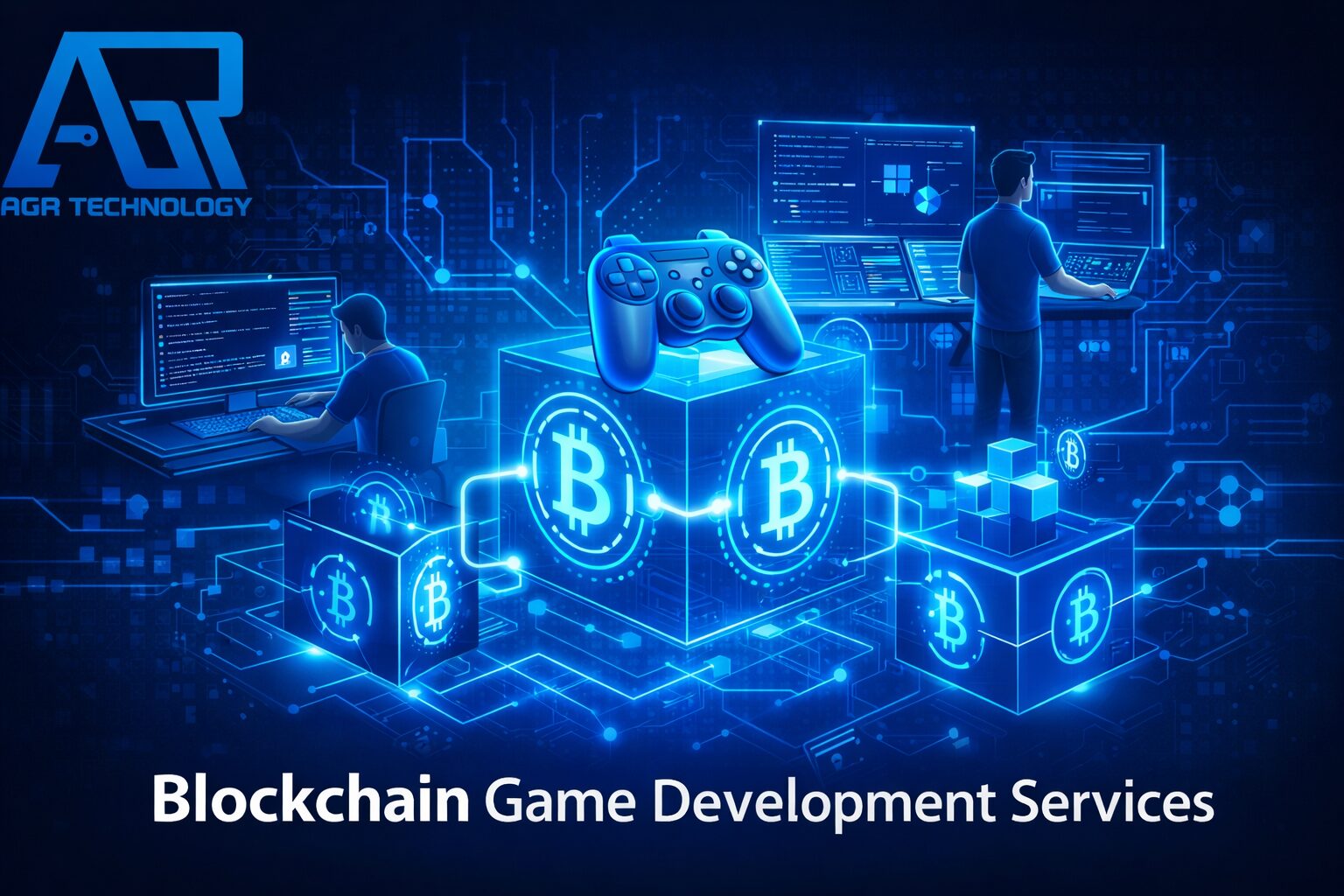
If you’re a business leader looking at blockchain gaming, you’re probably juggling two competing thoughts: “This could unlock new revenue and retention” and “This could turn into a costly science project.” That tension is normal.
Blockchain game development services are most valuable when they’re treated like a product and operations decision, not a hype-driven tech bet. In this guide, we’ll walk through what blockchain gaming actually is, the real use cases we see businesses pursue, what a professional delivery stack includes (smart contracts, wallets, analytics, anti-fraud, live ops), and how to scope a project you can defend on ROI.
At AGR Technology, we can build blockchain-enabled products alongside broader digital delivery (software, AI automation, marketing, and SEO) so the game isn’t just “launched,” it’s found, adopted, and operated reliably. If you want to talk through your idea, we’re happy to help you pressure-test it before you spend big.
Get in contact with us to discuss your project
Reviews from our happy clients:

Justine Brummans
Alessio is both incredibly knowledgeable and personable! He gave me great advice that was catered to me and my situation. Thank you Alessio! Super helpful!

Springfield Equestrian Park
Alessio is amazing! I can not speak highly enough of how helpful and knowledgeable he is, my website he created far exceeded my expectations, he is so accomodating and I can only wish him every success with his business. I rate AGR technology 10 out of 10.
Legacy Energy
We used AGR Technology and dealt with Alessio to design and build our website as well as host our emails. Alessio was a pleasure to deal with and had plenty of ideas that we could implement into our site. He has a great attention to detail, he is also very polite in understanding our goals and what we wanted to achieve with our website.
Thanks mate,
Alex & Rob
Excellent Service
Alessio developed our website for our business and has done a wonderful job. He is very personable and knowledgeable. We have enjoyed working with him. We will be referring others to him and highly recommend him to those who need Tech advice.
MRC Performance
I have been in business for over 10 Years and recently moved to AGR Technology for all our IT needs. They are able to fix nearly anything remotely and always very helpful in recommending appropriate hardware upgrades that do the job as required but not costing more than needed.

Alessio provided an excellent service. He was very dedicated in his method of finding solutions to problems. He continued to try different avenues until he found the reason as to why a particular application was not working. He was very knowledgeable in his understanding of the internet and of applications and how they work, and he was able to apply this knowledge in understanding how to resolve the obstacles that continued to appear. He is understanding towards his client's needs and goals and he is willing to work with his client in achieving those goals. He is a very polite and well mannered person and very calm and gentle in his approach. I would highly recommend Alessio's services to anyone.

Palmira Rigoli
Great work ethics Alessio! We at Totally Gluten Free Products are very happy to have you on board as our IT and SEO master. Very reliable, trustworthy and knowledgeable in the field.
YouTube Comment

Nat's Custom Designs
Alessio from AGR Technology has recently helped me create a website for my business.
Throughout the whole process from start to finish Alessio made the process easy for me, by calling me and explaining each step of the way. I'm not very computer savvy, but with Alessio taking the time to explain in detail everything I needed to know from putting inventory in to having it shipped. He even remotely joined my computer to help guide me through everything.
He's very knowledgeable and is experienced in everything I needed and if there was anything else I needed to know that wasn't something he was familiar with, he researched it.
I would HIGHLY recommend Alessio to anyone. He has not only helped me for now but I know that if I ever needed help with anything else he would definitely go above and beyond to help. Thank you so much for everything you have done. It's been a long process but well worth it 🙂
Byron Macumber
AGR Technology is amazing. not only do they stick with you through out the process, they also accommodate to your wants and needs. They are efficient in their work and they have high integrity. Their capabilities are shown through their website design, and appropriate knowledge of utilities regarding software. over the many years of working with them they have been fantastic. I would recommend to everyone
Very helpful
Alessio was thorough, diligent and kept me updated at all time points. I was very impressed with his performance, passion and dedication. I will continue to use his services.
Wantrup & Associates
Alessio of AGR Technology is an IT guy we rely on whenever we need IT help. His professionalism impressed us right at the first time. He solved many of our IT problems in no time. Excellent communication and speedy response.
We highly recommend this company
From a happy customer
Valeria Bianco
I received AGR contact information from a previous client, who had found their service excellent. So I contacted AGR with some expectations, and I can say they exceeded them. Professional, honest, punctual, reliable, their service is faultless. We can't recommend them highly enough.
Very fast, value for money and a comprehensive service
AGR is professional, organised and very skilled at what they do. They take the initiative, looking after all the details that you would not have thought of to enhance your website presence, marketing funnel and automated appointment bookings. Big bonus - pricings are at a fraction of the cost of competitors.
Customer testimonial
Alessio from AGR Technology is wonderful at gently guiding the less technically savvy users to solve problems. Back up service excellent. Highly recommended
SEO for website
The team is very cooperative and delivers clean and very efficient work.

Raimond Volpe
Nothing but good things to say about Alessio. He has been great service and great at communicating with me by both phone and email. Very good knowledge and problem-solving ability with our web development. I would thoroughly recommend Alessio and AGR Technology to anyone wanting online marketing or web development
Website design
Big thank you to Alessio at AGR Technology for a smooth and easy website development process. Nothing was to difficult to accomplish, I can highly recommend his first class service.
Proudly supporting clients of all sizes to succeed through digital solutions










Why work with us?





What Blockchain Gaming Is And Why It Matters
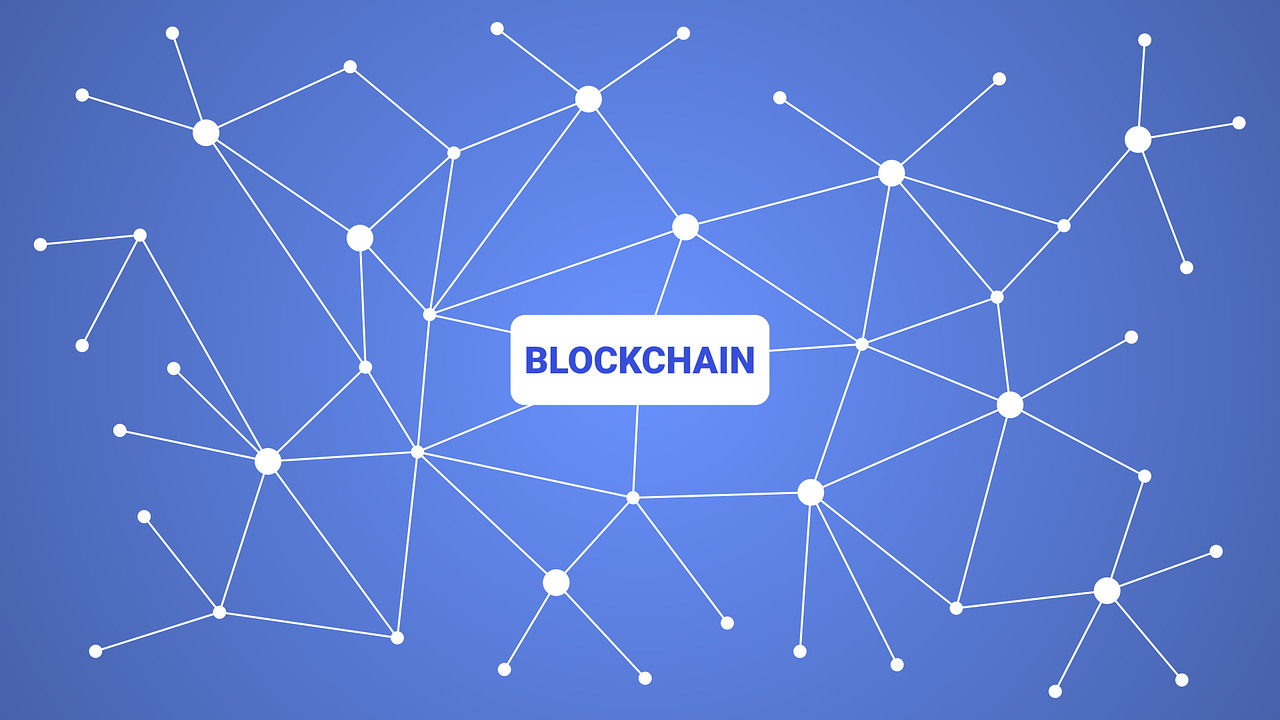
Blockchain gaming is the use of blockchain networks to manage certain game assets, rules, and transactions, usually via tokens and NFTs, so players can prove ownership, trade assets, or carry value outside the game’s database.
It matters for businesses because it can change three things at once:
- Monetization: new primary and secondary-market revenue models
- Retention: progression tied to ownership and community economies
- Distribution: community-led growth loops (marketplaces, creators, guilds)
But it only works when it’s designed carefully. If blockchain is bolted on after the fact, you often get high friction (wallet prompts, confusing fees) and low trust (scams, exploits, “pay-to-win” backlash).
Core Elements Of A Blockchain Game Stack
A practical blockchain game stack typically includes:
- Game client (mobile, PC, web) built in Unity/Unreal or web tech
- Game back-end (accounts, matchmaking, inventory, telemetry)
- Blockchain layer (smart contracts, token logic, NFT minting)
- Wallet + onboarding (custodial or non-custodial, account abstraction)
- Indexing and data APIs to read chain events efficiently
- Marketplace integrations (internal marketplace or external platforms)
- Security and fraud controls (contract audits, bot detection, monitoring)
We generally recommend deciding early what must be on-chain (true ownership, scarcity, settlement) and what should stay off-chain (real-time combat logic, most gameplay state) to keep performance and costs sane.
How Blockchain Changes Game Economies And Ownership
In traditional games, players “own” items in a practical sense, but legally and technically they’re usually licenses inside a publisher’s database.
Blockchain can shift that by enabling:
- Portable ownership: items can be held in a wallet, not just an account
- Player-to-player markets: transparent transfer history and pricing signals
- Programmable scarcity and utility: rules enforced by smart contracts
- Creator ecosystems: gated access, revenue splits, and community drops
The flip side is that economy design becomes a business-critical discipline. Once assets are tradable, inflation, speculation, and exploit risk show up fast. That’s why our blockchain game development services typically include tokenomics support, sink/source modeling, and monitoring plans, not just “mint NFTs.”
Common Types Of Blockchain Games And Use Cases

Businesses approach blockchain games with different goals: new revenue lines, customer loyalty, community growth, or even employee engagement in certain industries. The best use case depends on your audience’s tolerance for crypto UX and your willingness to operate an economy over time.
Play-To-Earn, Move-To-Earn, And SocialFi Mechanics
These models tie rewards to participation.
- Play-to-earn (P2E): players earn tokens/items through gameplay. Works best when rewards are balanced with strong sinks (upgrades, crafting, entry fees) and anti-bot controls.
- Move-to-earn (M2E): rewards are tied to activity signals (often via mobile sensors or wearables). Fraud prevention (GPS spoofing, emulator detection) becomes a first-order requirement.
- SocialFi mechanics: social actions (referrals, UGC, community quests) generate reputation or rewards. Great for community-led distribution, but you’ll want clear rules to avoid spam.
From a commercial lens, we usually ask: Are we rewarding “engagement,” or are we subsidizing it? Sustainable systems reward behaviors that create value for the ecosystem (content, competition, retention) rather than pure extraction.
Collectibles, Crafting, And Player-Driven Marketplaces
Collectible-heavy designs can be simpler to launch, especially when your core gameplay already works.
Common patterns include:
- Cosmetic collectibles: skins, badges, avatars, lower pay-to-win risk
- Crafting loops: burn multiple items to create one rarer item (a strong sink)
- Seasonal drops: time-boxed collections tied to live events
- Player-driven marketplaces: in-game listings with on-chain settlement
If your business has an existing brand or IP, collectibles can also function as membership + loyalty, where ownership unlocks gated perks (events, early access, premium content). We’ve seen this outperform pure speculation, because the value isn’t only resale, it’s ongoing utility.
If you’re exploring these models, we can help you map mechanics to business outcomes and decide what should be tradable, what should be soulbound/non-transferable, and how to keep the economy fair.
Key Components Included In Blockchain Game Development Services
When companies search for blockchain game development services, they often expect “smart contracts + a game.” In practice, a production-grade delivery includes the parts that keep players safe, keep costs controlled, and keep the game operable after launch.
Smart Contracts, Tokens, And NFT Standards
This is the on-chain core, typically including:
- Token contracts (if you have a fungible currency) with supply, distribution, and controls
- NFT contracts for items/characters/land
- Marketplace or trading contracts (if you support on-chain listings)
- Royalties and revenue splits (where compatible with marketplaces)
Common NFT standards are ERC-721 (unique items) and ERC-1155 (semi-fungible/batch items) on EVM chains. We choose standards based on inventory design, mint volume, and marketplace compatibility.
We also design for:
- Upgradability strategy (or intentionally immutable contracts)
- Admin permissions that are auditable and minimized
- Emergency controls (pause mechanisms) with strong governance
Wallets, Account Abstraction, And User Onboarding
UX is where many blockchain games lose players.
A good onboarding approach can include:
- Email/social login paired with a secure wallet model
- Account abstraction to reduce seed-phrase friction and enable smarter recovery
- Gas management (sponsored transactions or predictable fee flows)
- Fiat on-ramps where appropriate, so players aren’t forced to “buy crypto first”
We’ll usually run onboarding tests early. If a first-time player can’t get into the game in under a couple minutes, conversion suffers.
Back-End, Analytics, Anti-Fraud, And Live Ops Tooling
Even if assets are on-chain, your game still needs robust off-chain systems:
- Back-end services: profiles, progression, matchmaking, item metadata, server authority
- Analytics and telemetry: funnels, retention, LTV, economy health dashboards
- Anti-fraud/bot detection: rate limits, anomaly detection, device signals, on-chain heuristics
- Live ops tooling: content scheduling, drop configuration, event management, patch workflows
This is where AGR Technology’s broader delivery experience helps. We don’t treat blockchain as a silo: we integrate it with the systems you need for real operations, and we can align it with marketing and SEO so acquisition isn’t an afterthought.
If you want a clear list of what your project needs (and what it doesn’t), talk to us at AGR Technology via AGR Technology. We’ll help you define the stack before development starts.
Choosing The Right Blockchain, Tools, And Infrastructure
Choosing the wrong chain or infrastructure is one of the fastest ways to bake in unnecessary fees, UX friction, and future migrations. We prefer to select based on the product requirements, not what’s trending.
Chain Selection: Fees, Throughput, Security, And Ecosystem
We typically evaluate chains by:
- Fees and fee predictability: are costs low enough for your expected transaction volume?
- Throughput and finality: can the network handle peak events without frustrating delays?
- Security model: track record, decentralization, validator set, bridges (if used)
- Ecosystem fit: wallets, marketplace support, developer tooling, community liquidity
- Compliance considerations: availability of compliant on-ramps and regional constraints
Many commercial games use EVM-compatible networks because the tooling and talent pool are deep. Others choose appchains or L2s when they need more control. The key is matching chain tradeoffs to your design: are you minting often, trading often, or mostly verifying ownership occasionally?
Game Engines And Middleware: Unity, Unreal, And Web Tech
Your engine choice drives hiring, performance, and platform reach:
- Unity: common for mobile and casual games: large dev ecosystem
- Unreal Engine: strong for high-fidelity visuals and complex worlds
- Web tech (WebGL/WebGPU + frameworks): fast distribution, easy onboarding, great for lighter-weight experiences
Blockchain integration can happen through SDKs, wallet providers, and custom middleware. We’ll aim to keep chain calls minimal and asynchronous so gameplay doesn’t “wait on the blockchain.”
Infrastructure: Indexers, Oracles, Storage, And RPC Providers
To run reliably, blockchain games depend on infrastructure layers that most players never see:
- RPC providers: stable access to read/write transactions
- Indexers: fast queries for ownership, listings, and event history
- Oracles: external data feeds (carefully used, attack surface matters)
- Decentralized or hybrid storage: metadata, images, and asset references
We design for redundancy and observability (alerts, logs, metrics), because downtime in a live economy isn’t just inconvenient, it can become a trust event.
If you’re unsure which infrastructure is “enough,” we can propose an MVP-friendly setup that scales cleanly, without overengineering on day one.
Security, Compliance, And Trust Considerations
Security and compliance aren’t side quests in blockchain gaming, they’re the main storyline. One exploit can undo months of brand-building.
Smart Contract Audits And Threat Modeling
Smart contracts are public, adversarial code. We approach security with:
- Threat modeling: identify what can be stolen, manipulated, or spammed (tokens, mints, reward claims, marketplace flows)
- Secure-by-design patterns: least privilege, clear admin separation, predictable upgrade paths
- Testing: unit tests, integration tests, fuzzing where appropriate
- Independent audits: external review for high-risk contracts (especially marketplaces, bridges, reward systems)
- Monitoring and incident response: alerts for unusual mints, transfers, price manipulation, and contract calls
A practical note: audits reduce risk, but they don’t eliminate it. Your best defense is layered, good design, good code, and good ops.
Regulatory And Marketplace Constraints (Regions, KYC, Taxes)
Rules vary by region and by the exact mechanics of your game. Common constraints include:
- KYC/AML requirements if you’re enabling certain cash-out flows or operating custodial systems
- Marketplace policies (some platforms restrict certain token mechanics)
- Tax implications for rewards and trading (for both the business and players)
- Age gating and consumer protections depending on your audience
We’re not a law firm, and we don’t pretend to be. What we do is build with compliance in mind and coordinate with your legal counsel on requirements, user flows, and record-keeping. That tends to be far cheaper than rebuilding systems after launch.
If your team is worried about “doing this safely,” that’s a good sign. Let’s discuss your risk profile and design guardrails early.
How To Scope A Blockchain Game Project And Estimate Cost
Cost in blockchain game development is mostly determined by scope clarity. The more you can decide up front, what’s on-chain, what’s off-chain, what’s tradable, and how onboarding works, the more accurate your estimate will be.
MVP Vs Full Launch: Features That Drive ROI
For most businesses, the highest-ROI path is a focused MVP that proves:
- Players can onboard without confusion
- The core loop is fun (still the #1 growth driver)
- The economy is stable enough to run for weeks, not hours
- Marketplace behavior is legitimate (low fraud, low botting)
Typical MVP features that matter:
- One or two asset types (e.g., characters + cosmetics)
- A limited set of on-chain actions (mint, transfer, maybe crafting)
- Basic marketplace or trading (sometimes delayed to phase 2)
- Analytics dashboards for retention and economy sinks/sources
Full launch usually adds:
- Multiple game modes, seasons, and live events
- Advanced crafting, guild systems, lending/rentals
- Multi-chain support (only if you truly need it)
- Deeper compliance workflows and customer support tooling
We’ll be candid here: if the business case depends entirely on tokens “going up,” it’s not a business case. We scope for durable value, content, community, and utility.
Typical Timelines, Team Roles, And Delivery Milestones
Timelines vary by complexity, but most serious projects follow milestones like:
- Discovery (2–4 weeks): product goals, economy design, chain selection, architecture
- Prototype (4–8 weeks): core gameplay loop + basic on-chain integration
- MVP build (8–16+ weeks): production back-end, wallet UX, contracts, analytics
- Testnet + security review (2–6 weeks): audits, load testing, exploit simulation
- Launch + live ops: phased rollout, monitoring, content cadence
Typical roles include:
- Product lead / producer
- Game designers (systems + economy)
- Unity/Unreal/web engineers
- Smart contract engineers
- Back-end engineers
- QA + security reviewers
- DevOps/SRE for infrastructure and monitoring
Want a realistic estimate? At AGR Technology, we can run a structured scoping workshop and leave you with a clear plan: deliverables, milestones, risks, and budget ranges. Start the conversation with us.
Conclusion
Blockchain gaming can be a strong commercial move when it’s built around solid gameplay, sensible ownership mechanics, and a real operations plan. The companies that win here aren’t chasing novelty, they’re designing trustworthy economies, reducing onboarding friction, and treating security as a product feature.
If you’re exploring blockchain game development services and want a practical plan (not a pitch deck), we can help. Reach out to AGR Technology to book a scoping call. We’ll walk through your goals, recommend an MVP that proves ROI, and map the tech stack, timeline, and security requirements so you can make a confident decision.
Frequently Asked Questions (FAQs)
What are blockchain game development services, and what do they include?
Blockchain game development services cover more than “a game + smart contracts.” A production stack typically includes the game client, back-end services, smart contracts (tokens/NFTs), wallet onboarding, indexers/data APIs, marketplace integration, analytics/telemetry, anti-fraud controls, and live ops tooling so the economy stays reliable after launch.
What is blockchain gaming, and why does it matter for monetization and retention?
Blockchain gaming uses blockchain networks to manage certain assets, rules, and transactions so players can prove ownership and trade items outside a publisher database. For businesses, it can unlock new monetization models, improve retention through ownership-based progression, and enable community-led distribution via marketplaces, creators, and guild growth loops.
How do you decide what should be on-chain vs off-chain in a blockchain game?
Put on-chain what benefits from verifiable ownership, scarcity, and settlement (NFTs, trades, key token rules). Keep off-chain most real-time gameplay state (combat logic, matchmaking, moment-to-moment progression) to protect performance and cost. Deciding this early makes estimates more accurate and reduces future rework.
Which NFT standards are used in blockchain game development services (ERC-721 vs ERC-1155)?
On EVM networks, ERC-721 is commonly used for truly unique assets (one-of-one items or characters), while ERC-1155 fits semi-fungible or batch-minted inventory (stackable items, large drop volumes). The best choice depends on inventory design, expected mint volume, and marketplace compatibility requirements.
How can you reduce wallet friction and onboarding drop-off in blockchain games?
To lower friction, teams often use email/social login with a secure wallet model, account abstraction to avoid seed-phrase pain, and gas strategies like sponsored or predictable fees. Fiat on-ramps can also help players start without buying crypto first. Early onboarding tests are crucial for conversion.
How much does a blockchain game cost and how long does it take to build?
Cost and timeline depend on scope clarity—especially what’s on-chain, what’s tradable, and how onboarding works. Many projects follow milestones like discovery (2–4 weeks), prototype (4–8 weeks), MVP build (8–16+ weeks), then testnet/security review (2–6 weeks) before a phased launch with live ops.
Other solutions:
eWallet Mobile App Development
Cloud Application Security Services