![logo-new-23[1]](https://agrtech.com.au/wp-content/uploads/elementor/thumbs/logo-new-231-qad2sqbr9f0wlvza81xod18hkirbk9apc0elfhpco4.png "logo-new-23[1]")

Artificial intelligence is everywhere in business right now, inside customer support bots, forecasting tools, search engines, fraud systems, CRMs, and increasingly, everyday workflows. But as interest in automation grows, so does confusion around a related term: AGI, or artificial general intelligence. The two are often used interchangeably, and that creates bad assumptions, inflated expectations, and sometimes expensive strategy mistakes.
For businesses investing in digital transformation, the difference matters. Today’s AI can already deliver real value, from faster operations to better decision support. AGI, by contrast, remains largely theoretical: a system with human-like general problem-solving ability across many domains, not just one task. Understanding where current tools end, and where future possibilities begin, helps companies make smarter bets now.
For organizations evaluating AI automation, custom software, and long-term tech strategy, this is the practical question: what is available today, what is still speculative, and how should a business prepare for both?
Key Takeaways
- AI vs AGI matters because today’s AI delivers value in specific tasks, while AGI would require human-like reasoning across many domains.
- Businesses should treat current AI as a practical productivity and automation tool, not as proof that AGI already exists.
- Generative AI can speed up writing, analysis, support, and coding, but it still needs validation, guardrails, and human oversight.
- The biggest gaps between AI and AGI are general reasoning, adaptability, long-term context, and safe autonomous decision-making.
- Companies get the best results by applying AI to measurable workflows now while building strong data, governance, and AI literacy foundations for the future.
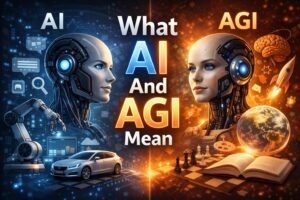
What AI And AGI Mean
What Artificial Intelligence Is Today
Artificial intelligence today mostly refers to narrow AI, systems designed to perform specific tasks using data, rules, statistical modeling, or machine learning. That includes recommendation engines, document classification, computer vision, speech recognition, demand forecasting, and large language models that generate text or code.
In business settings, this is the AI that matters right now. It can summarize reports, route support tickets, detect anomalies in transactions, optimize ad campaigns, and help teams work faster. But it does not “understand” the world the way people do. It works within patterns it has learned from training data and prompts, often very impressively, but still within a bounded scope.
That distinction is easy to miss because modern AI can feel broad. A generative model might write emails in the morning, help draft software in the afternoon, and answer HR questions by evening. Still, that flexibility comes from pattern recognition across huge datasets, not from general human-like intelligence.
What Artificial General Intelligence Would Be
Artificial general intelligence would be something fundamentally different. AGI is generally described as a system capable of performing a wide range of intellectual tasks at or near human level, with the ability to reason across domains, learn new concepts with limited instruction, transfer knowledge from one context to another, and adapt to unfamiliar environments.
In plain terms, AGI would not just complete a task it was trained for. It could potentially tackle a new business problem, ask useful clarifying questions, build a plan, test assumptions, adjust when conditions change, and apply lessons elsewhere, much like a skilled human operator or strategist.
That is why the AI vs AGI conversation matters. One is already driving measurable gains in efficiency and automation. The other represents a possible future shift in how work, software, and decision-making operate at a much deeper level. Businesses need to recognize that they are not the same thing, even if headlines blur the line.
The Core Differences Between AI And AGI
Scope Of Capability
The biggest difference between AI and AGI is scope. Current AI systems are excellent in narrow or semi-broad domains, especially when the task is well-defined. A model can identify defects on a production line, generate product descriptions, or forecast churn with remarkable accuracy. But ask it to move fluidly between legal reasoning, financial planning, scientific hypothesis testing, and operational leadership with true understanding, and the limits appear fast.
AGI, by definition, would have far wider capability. It would not depend on separate systems for each domain in the same way. Instead, it could apply a more general intelligence across many kinds of problems.
Learning, Reasoning, And Adaptability
Current AI can learn, but usually in constrained ways. It often needs substantial training data, careful tuning, clear prompts, or structured environments. Even advanced systems can struggle with common-sense reasoning, long-term consistency, and situations that differ from training patterns.
AGI would need stronger reasoning and adaptability. It would likely have to learn from fewer examples, handle ambiguity better, maintain context over longer horizons, and adjust to novel scenarios without constant retraining. That’s a very high bar. Many AI tools appear intelligent in demos, yet break when reality gets messy, which, as every business knows, it usually does.
Autonomy And Decision-Making
Another major difference is autonomy. Today’s business AI usually works best as a copilot, not a fully independent operator. It can recommend next actions, draft content, score leads, or detect risks. Human oversight still matters because models can hallucinate, misclassify, or make poor decisions outside their intended lane.
AGI would imply a much greater degree of autonomous decision-making. It could potentially manage goals, interpret changing conditions, and make multi-step choices without needing constant supervision. That possibility is exciting, but it also raises serious governance questions. The more autonomy a system has, the higher the stakes if its reasoning is flawed, biased, misaligned, or simply opaque.
Where Current Business AI Fits In
Common Enterprise Uses Of Narrow AI
Most business use cases today sit firmly in the narrow AI category, and that is not a weakness. Narrow AI is where practical ROI lives.
Common enterprise applications include:
- Customer service automation through chatbots, triage systems, and knowledge assistants
- Marketing optimization for SEO insights, audience targeting, personalization, and campaign analysis
- Sales support through lead scoring, forecasting, and proposal drafting
- Operations automation for document processing, workflow routing, scheduling, and inventory analysis
- Risk and compliance monitoring using anomaly detection and pattern-based alerts
- Software development support through code suggestions, testing assistance, and documentation generation
For many businesses, the near-term opportunity is not chasing futuristic AGI. It is connecting existing AI tools to real processes, quality data, and measurable goals. That might mean reducing manual admin time, speeding up internal search, automating repetitive support tasks, or building custom AI workflows into a company’s software stack.
This is also where digital partners such as AGR Technology fit naturally. Businesses often do not need a flashy AI experiment: they need integrated systems that combine automation, software development, search visibility, and process improvement into something that actually works in production.
Why Generative AI Is Powerful But Not AGI
Generative AI has changed the conversation because it feels more flexible than earlier AI systems. A single model can write copy, summarize meetings, analyze documents, create images, or help build scripts. That broad usability leads some people to assume AGI is basically here already.
It isn’t.
Generative AI is powerful because it predicts and composes outputs based on massive pattern learning. It can simulate expertise convincingly, sometimes uncannily so. But simulation is not the same as grounded understanding. These systems still make factual mistakes, lose track of context, struggle with true causal reasoning, and depend heavily on prompts, tools, and guardrails.
In business terms, generative AI is best viewed as a high-leverage productivity layer. It can accelerate writing, analysis, support, coding, and internal knowledge access. But it still needs process design, validation, and oversight. Treating it like AGI is where organizations get into trouble.
How Close We Are To AGI
Technical Barriers Still In The Way
Even though rapid progress, significant barriers remain between current AI and true AGI. Researchers still debate what ingredients are missing, but several challenges show up repeatedly.
First, robust reasoning is unresolved. Many models are strong at pattern matching yet inconsistent at logic-heavy tasks, long-horizon planning, and causal inference.
Second, reliable memory and context management remain limited. Real-world business decisions often require continuity across time, departments, exceptions, and changing priorities. Today’s systems can assist with that, but not fully own it.
Third, grounded understanding is still weak. AI can manipulate language without genuinely experiencing the physical or social world the way humans do. Whether AGI requires that kind of grounding is debated, but the gap matters.
Fourth, alignment and control are not solved. Even if systems become more capable, ensuring they pursue goals safely and predictably is another challenge altogether.
And then there’s compute, energy use, data quality, model architecture, evaluation standards… none of this is trivial.
Why Predictions About AGI Vary So Widely
Predictions about AGI range from “a few years away” to “decades away” to “possibly never in the way people imagine.” That spread exists because no single definition of AGI has universal agreement, and because progress in AI is uneven. One year brings major breakthroughs in multimodal models: another exposes stubborn weaknesses in reasoning or reliability.
There is also a difference between economic usefulness and scientific achievement. A system does not need to be true AGI to transform industries. Businesses may feel the impact of highly capable AI long before researchers agree that AGI has arrived.
That is why leaders should be careful with bold timelines. Forecasts make for good headlines, but strategy should be based on present capabilities, plausible near-term developments, and governance readiness, not hype cycles. A company that waits for AGI may miss huge benefits available now. A company that assumes AGI already exists may automate itself into avoidable risk.
What AGI Could Mean For Businesses And Society
Opportunities For Productivity And Innovation
If AGI were achieved, the impact on business could be profound. It could move beyond assisting with tasks to handling complex, cross-functional work that currently requires experienced human teams. Strategy modeling, R&D acceleration, autonomous software creation, dynamic supply chain decisions, and real-time enterprise orchestration could all change dramatically.
For businesses, that might mean:
- Faster innovation cycles
- Lower operational friction
- More adaptive products and services
- Better decision support at scale
- New business models built around intelligent systems
On a societal level, AGI could help tackle hard problems in healthcare, science, education, logistics, and climate-related planning. The upside case is enormous.
Risks, Governance, And Ethical Concerns
But so is the downside.
More capable systems could intensify concerns around labor displacement, concentration of power, cybersecurity misuse, surveillance, misinformation, and accountability. If an autonomous system makes a harmful decision, who is responsible? If AGI-level capabilities are controlled by a handful of firms or states, what does that mean for competition and public trust?
Businesses do not need to wait for AGI to grapple with these issues, either. Versions of them already exist in current AI deployments: bias in decision systems, poor data governance, black-box outputs, and weak human oversight.
That makes governance a business issue, not just a technical one. Policies for data quality, model testing, security, privacy, escalation, and human review should not be afterthoughts. The more advanced AI becomes, the less room there is for “we’ll sort it out later.”
How Businesses Should Prepare Now
Focus On Practical AI Adoption
The smartest response to the AI vs AGI debate is not panic or passivity. It is disciplined action.
Businesses should focus first on practical AI adoption with clear commercial outcomes. That means identifying repetitive workflows, information bottlenecks, customer pain points, and areas where decision support can improve speed or accuracy. Start with use cases that are measurable and operationally grounded.
Good questions include:
- Where is staff time being lost to manual work?
- Which decisions rely on slow document review or fragmented knowledge?
- What customer interactions could be improved with smarter automation?
- Which functions would benefit from custom software plus AI, rather than off-the-shelf tools alone?
A phased approach usually works best: pilot, validate, govern, then scale.
Build Governance, Data, And Skills Foundations
Preparation for more advanced AI starts with fundamentals. Businesses need clean, accessible data: clear process ownership: secure infrastructure: and teams that understand both the potential and limitations of AI.
That includes:
- Building internal AI literacy for leadership and operational teams
- Establishing governance standards for privacy, security, and quality control
- Creating human-in-the-loop review for sensitive outputs
- Investing in data architecture that supports reliable automation
- Working with experienced partners when custom implementation is needed
For organizations pursuing long-term transformation, this foundation matters more than trying to predict the exact arrival date of AGI. Companies that strengthen data, workflows, governance, and technical capability today will be in a much better position whether the future brings more advanced narrow AI, agentic systems, or something closer to AGI.
In other words: prepare for progress, not science fiction.
Conclusion
AI and AGI are related, but they are not interchangeable. Current AI is already useful, commercially valuable, and increasingly essential to how modern businesses operate. AGI remains a bigger, more uncertain idea, one that could redefine work and decision-making if it arrives, but one that should not distract leaders from immediate opportunities.
For businesses across industries, the practical move is clear: use today’s AI where it creates real value, build strong governance and data foundations, and stay informed without getting pulled into hype. The companies that win will not necessarily be the ones making the loudest predictions about AGI. They will be the ones applying AI thoughtfully, integrating it into real operations, and staying ready for what comes next.
Need help implementing AI solutions for your business? Contact AGR Technology today to see how we can help prepare your business for the future
Frequently Asked Questions
What is the main difference between AI vs AGI in business terms?
The biggest difference in AI vs AGI is scope. Today’s AI is narrow and task-specific, helping with things like forecasting, support, or content generation. AGI would be able to reason across many domains, adapt to new problems, and make broader decisions more like a human.
Is generative AI the same as AGI?
No. Generative AI is a powerful form of narrow AI that can create text, images, code, and summaries from learned patterns. It may seem broadly capable, but it still lacks human-like understanding, reliable reasoning, and true cross-domain autonomy, which are central ideas in AGI.
How are businesses using artificial intelligence today?
Most companies use artificial intelligence for practical, measurable tasks such as customer service automation, lead scoring, document processing, fraud detection, workflow routing, marketing optimization, and coding support. These narrow AI applications can improve efficiency and decision support without requiring speculative AGI-level capabilities.
How close are we to AGI?
No one knows for sure. Some experts think AGI could arrive within years, while others believe it may take decades or never appear as commonly imagined. Major barriers still include reasoning, long-term memory, context handling, grounded understanding, alignment, and reliable control in messy real-world conditions.
Why does the AI vs AGI distinction matter for companies making tech investments?
Confusing AI vs AGI can lead businesses to overestimate current tools or delay useful projects while waiting for future breakthroughs. Understanding the difference helps leaders invest in proven AI solutions now, set realistic expectations, and build governance, data, and workflow foundations for more advanced systems later.
How should a business prepare for AI now if AGI is still uncertain?
The best approach is to focus on practical AI adoption with clear outcomes. Start with repetitive workflows, information bottlenecks, and customer pain points, then pilot, validate, and scale. At the same time, strengthen data quality, security, human oversight, and internal AI literacy so the business is ready for future advances.
Related resources:
What Is Generative Engine Optimization
AI Voice Agent Development Services

Alessio Rigoli is the founder of AGR Technology and got his start working in the IT space originally in Education and then in the private sector helping businesses in various industries. Alessio maintains the blog and is interested in a number of different topics emerging and current such as Digital marketing, Software development, Cryptocurrency/Blockchain, Cyber security, Linux and more.
Alessio Rigoli, AGR Technology