

If you’ve ever been offered a “DR 70 backlink” and wondered whether it’s worth the money, you’re not alone. Domain Rating is one of the most quoted SEO metrics, but it’s also one of the easiest to misuse. At AGR Technology, we see this often: businesses chasing high-DR links while ignoring relevance, traffic, placement, and risk. The result is usually wasted budget, and sometimes a backlink profile that needs cleaning up later.
What Domain Rating Actually Measures
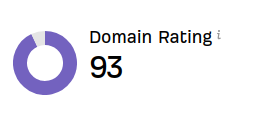
Domain Rating, or DR, is an Ahrefs metric that estimates the strength of a website’s backlink profile on a 0–100 logarithmic scale. In simple terms, a site with many links from other strong sites will usually have a higher DR.
That makes DR useful as a quick comparison point. It can help us understand whether a website has attracted links at scale. But it does not tell us whether a specific backlink is useful, safe, relevant, or likely to improve rankings.
Ahrefs explains DR as a third-party metric based mainly on referring domains and link equity. It is not a Google metric. Google has never said it uses DR, DA, or any similar third-party authority score as a ranking factor.
That distinction matters. DR measures the broad strength of a domain’s backlink profile. Google evaluates links using far more detail, including page context, topical relevance, anchor text, link placement, quality signals, and whether the link appears natural.
So, DR is a snapshot. It is not a verdict.
Why High DR Does Not Always Mean A High-Quality Backlink
A high-DR backlink can be valuable. But it can also be weak, irrelevant, or risky.
The problem is that DR is domain-level. It does not automatically reflect the quality of the exact page linking to you. A large website might have DR 80, but your link could sit on a thin, buried page with no traffic, no relevance, and no editorial value.
We also see inflated DR used as a sales tactic. Some link sellers build or acquire expired domains, connect networks of low-quality sites, and push authority metrics upward. On paper, those sites look impressive. In practice, they often have poor content, unnatural outbound links, and little real audience.
Common warning signs include:
- A high DR site with almost no organic traffic
- Dozens of unrelated outbound links on every page
- Articles written only to host paid links
- No real business, author, editorial process, or audience
- Topics that jump from finance to pets to casinos to software in one week
Google’s spam policies are clear about link schemes. If a link exists mainly to manipulate rankings, it can be ignored or treated as a problem. High DR does not protect a bad link from being devalued.
What Google Is More Likely To Value In A Backlink
Google is more likely to value backlinks that make sense for users first. That sounds basic, but it’s the part many SEO campaigns skip.
A strong backlink usually has three things working together: relevance, trust, and context.
Relevance means the linking page and your page belong in the same conversation. If a cybersecurity company earns a link from an article about data protection, that’s relevant. If the same company gets a link from a random travel blog, the SEO value is much less convincing.
Trust comes from the quality of the source. Is the website real? Does it publish useful content? Does it have an audience? Is it cited by others? Does it avoid spammy outbound linking patterns?
Context is about placement. A link inside a helpful paragraph that supports the topic is very different from a link dropped into a generic author bio or footer.
Page-level quality also matters. Google ranks pages, not just domains. A lower-DR site with a highly relevant, well-read article can be more useful than a high-DR site where your link sits on a page nobody visits.
This is why AGR Technology approaches link building as part of a wider SEO strategy, not a numbers game. We look at whether a backlink can support rankings, referral traffic, brand trust, and long-term search visibility.
When DR Is Still Useful In Link Building
DR is not useless. It just needs to be used in the right place.
We use DR as an initial filter, not the final decision. It can help identify whether a site has a backlink profile worth reviewing. It can also support competitor analysis by showing how your domain compares against others in your market.
For example, if your main competitors all sit around DR 55 and your site is DR 12, that gap may point to a broader authority issue. It does not mean you should chase any DR 55 link you can find. It means you may need a stronger digital PR, content, and outreach strategy.
DR is also useful for spotting patterns over time. If your DR grows while organic traffic, keyword rankings, and referring domains also improve, that’s usually a good sign. If DR grows but traffic stays flat, something may be off.
The best use of DR is comparative, not absolute. It helps answer questions like:
- Are competitors earning more links from trusted sites?
- Is our authority improving over time?
- Which prospects deserve closer manual review?
- Are we building links from a healthy mix of sources?
Used this way, DR supports better judgment. It doesn’t replace it.
A Smarter Checklist For Evaluating Backlink Quality
Before approving a backlink opportunity, we recommend checking more than DR. A simple manual review can prevent expensive mistakes.
Use this checklist:
- Topical relevance
Does the linking website cover your industry, service, product, or audience? A relevant DR 35 link can beat an irrelevant DR 80 link.
- Page relevance
Does the exact page linking to you support the topic naturally? The surrounding content should make the link feel useful, not forced.
- Organic traffic
Does the site receive real search traffic? A high-DR site with no traffic may have authority metrics but little practical value.
- Editorial standards
Are articles reviewed, attributed, and written for readers? Thin guest post farms are rarely worth the risk.
- Outbound link patterns
Check whether the site links to unrelated or questionable industries. Too many commercial outbound links can be a red flag.
- Anchor text
Natural anchor text is safer. Exact-match anchors repeated across many sites can look manipulative.
- Link placement
In-content editorial links are usually stronger than sidebar, footer, directory, or author bio links.
- Business value
Would you still want the link if Google ignored it? If it could send qualified traffic or build credibility, that’s a good sign.
For businesses that don’t have time to review every prospect, AGR Technology can help audit backlinks, identify toxic patterns, and build a safer link acquisition plan tied to real SEO outcomes.
Conclusion
DR can help with SEO research, but it should never be the main way to judge backlink quality. Google is more likely to reward links that are relevant, trusted, contextual, and useful to real people.
If you want a cleaner, safer backlink strategy, speak with AGR Technology. We can review your current link profile and help you build authority that supports long-term growth.
Get in touch to see how we can help
Frequently Asked Questions about Domain Rating and Backlink Evaluation
What does Domain Rating (DR) measure in SEO?
Domain Rating (DR) is a third-party metric by Ahrefs that estimates the strength of a website’s backlink profile on a 0–100 scale, based mainly on referring domains and link equity, but it does not directly measure Google ranking factors.
Why is DR not the best way to evaluate backlink quality?
DR is a domain-level metric and doesn’t assess the specific page quality, relevance, trust, or context of a backlink. High DR links may come from irrelevant or low-traffic pages, making DR insufficient for judging true backlink value.
What factors does Google consider when evaluating backlink quality?
Google values backlinks that are relevant, trustworthy, placed contextually within helpful content, and come from pages with real traffic. It assesses page-level signals like topical relevance, anchor text, link placement, and editorial standards.
How can I use Domain Rating effectively in link building strategies?
Use DR as an initial filter to compare your domain against competitors and identify potential link opportunities, but always manually review each prospect for relevance, traffic, editorial quality, and contextual fit before pursuing a backlink.
Can a backlink from a low-DR site be more valuable than one from a high-DR site?
Yes, a relevant backlink from a lower-DR site with high-quality, well-trafficked content and editorial integrity can provide more SEO value than a high-DR backlink from an unrelated or low-traffic page.
How can I ensure my backlink strategy aligns with Google’s ranking approach?
Focus on earning links that make sense to users by prioritizing relevance, trustworthiness, natural anchor text, and contextual placement. Avoid relying solely on metrics like DR; instead, adopt a comprehensive approach that supports long-term search visibility and brand trust.
Related content:
When Should I Start Link Building For A New Website?
Digital PR Services for SaaS & Technology Brands
How Local SEO Affects Foot Traffic for Brick-and-Mortar Shop

Alessio Rigoli is the founder of AGR Technology and got his start working in the IT space originally in Education and then in the private sector helping businesses in various industries. Alessio maintains the blog and is interested in a number of different topics emerging and current such as Digital marketing, Software development, Cryptocurrency/Blockchain, Cyber security, Linux and more.
Alessio Rigoli, AGR Technology