

Ranking a new website for a competitive search term can take months, or longer. Parasite SEO offers a shortcut of sorts: instead of waiting for our own domain to build authority, we publish content on an established third-party platform that already has search visibility, trust, and an audience.
That can produce faster rankings, valuable referral traffic, and early insight into whether a keyword converts. But the tactic has a less attractive side. Low-quality campaigns may exploit a host website’s reputation, violate editorial policies, or fall within Google’s definition of site reputation abuse.
So, what is parasite SEO in practical terms, and can businesses use it responsibly? In this guide, we’ll explain how the strategy works, examine its ethical and high-risk forms, and help determine whether it belongs in a wider digital marketing plan. The aim isn’t to chase a temporary loophole. It’s to use third-party distribution intelligently while continuing to build digital assets we actually control.
Key Takeaways
- Parasite SEO involves publishing content on authoritative third-party websites to leverage their existing search strength and gain faster visibility.
- This strategy accelerates ranking for competitive queries but does not transfer ownership or control of the content or page to the publisher.
- Effective parasite SEO requires creating high-quality, relevant, and platform-native content that genuinely serves the host’s audience and follows editorial guidelines.
- Parasite SEO complements owned SEO efforts by providing early visibility, testing keyword demand, and driving referral traffic without replacing long-term site development.
- Risks include loss of content control, potential violation of Google’s reputation abuse policy, and dependence on host platforms, so it should be used cautiously within a diversified SEO strategy.
- Start with pilot campaigns on relevant authoritative sites to measure commercial outcomes like leads and conversions before scaling parasite SEO efforts.
Key Takeaways
Parasite SEO means publishing optimized content on an authoritative third-party website to benefit from that domain’s existing search strength. The host might be an industry publication, user-generated content platform, forum, professional network, video website, or reputable media outlet.
The essential points are:
- It can accelerate visibility. A trusted platform may rank for a competitive query much faster than a young or low-authority business website.
- It doesn’t transfer ownership. The host controls the page, policies, links, monetization options, and sometimes the content itself. It can edit or remove our publication without warning.
- Quality and relevance matter. The safest campaigns serve the host platform’s audience with genuinely useful material. Publishing thin, unrelated, or excessively commercial pages creates reputational and search risks.
- Parasite SEO isn’t automatically black hat. A credible guest article, useful LinkedIn post, expert contribution, or relevant community answer can be legitimate digital PR. The ethical status depends on intent, quality, disclosure, and execution.
- Google scrutinizes reputation abuse. Third-party pages created mainly to exploit a host domain’s ranking signals may be treated as spam. Editorial involvement alone doesn’t necessarily make an arrangement safe.
- It should complement owned SEO. Third-party rankings can provide a quick lift, but technical SEO, original content, links, and conversion-focused pages on our own domain create longer-term value.
- Starting small is sensible. Testing a few carefully selected platforms helps us evaluate rankings, referral traffic, leads, moderation requirements, and commercial returns before scaling.
The useful mental model is distribution, not dependency. We’re borrowing access to an established audience and reputation: we aren’t building on land we own.
How Parasite SEO Works
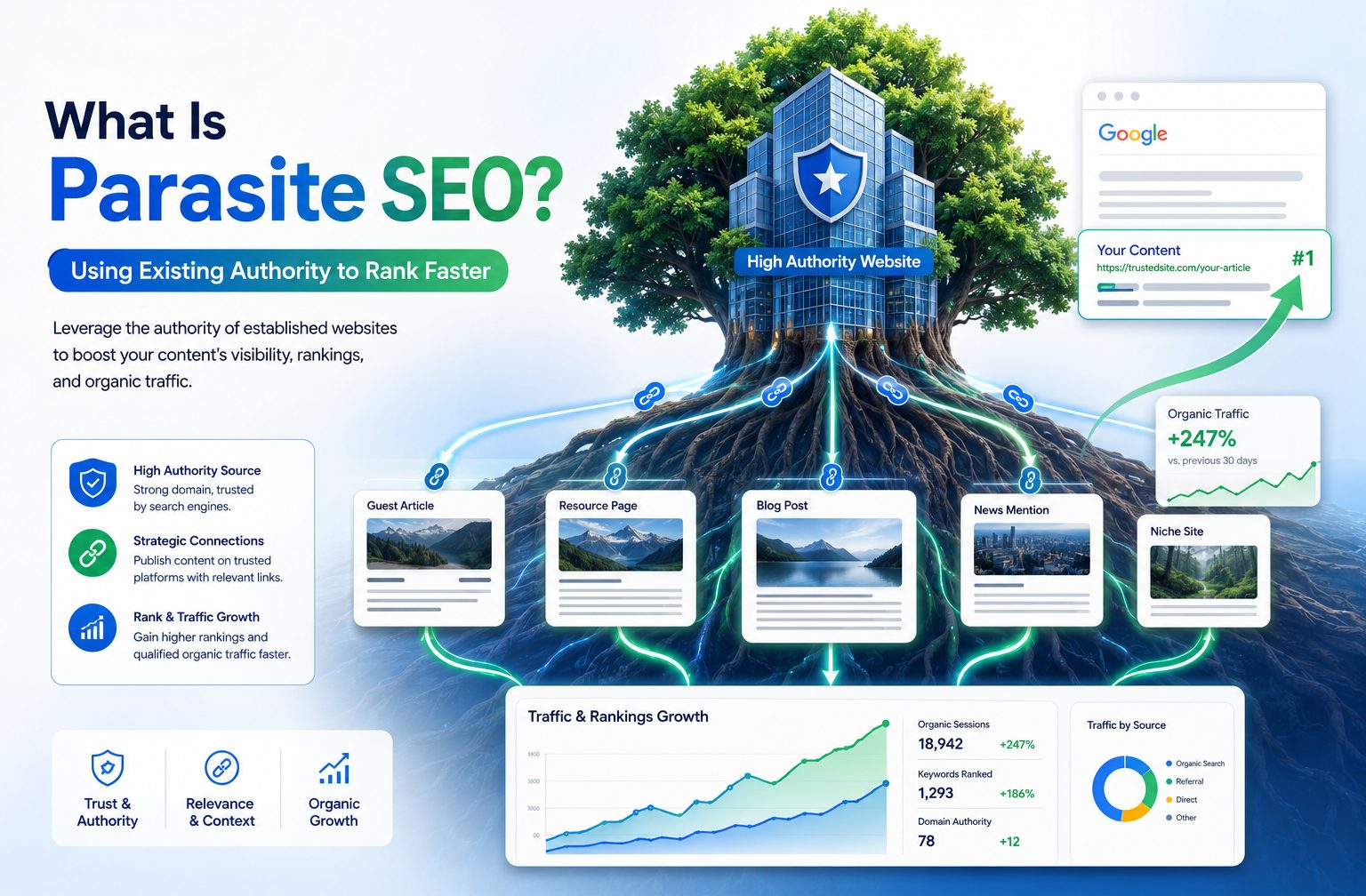
Search engines assess pages using many signals, including relevance, content quality, links, topical context, and the reputation of the website hosting the page. A newly registered domain generally has limited history and few authoritative links. Even an excellent article can hence struggle against established competitors.
Parasite SEO changes the starting position. We place the article, video, profile, or discussion on a website that search engines already crawl frequently and understand well. If that platform is relevant to the topic, its established authority can help the individual page gain visibility sooner.
A typical campaign follows several steps:
- Select a realistic query. We examine search intent, competition, business value, and the formats already ranking. A video query may suit YouTube: a professional subject might fit LinkedIn or an industry journal.
- Choose a relevant host. Authority alone isn’t enough. A finance guide belongs on a respected business or finance platform, not an unrelated entertainment site that happens to have strong metrics.
- Create platform-native content. The piece should satisfy the audience where it appears. Copying a sales page into Medium or dropping promotional links into Reddit rarely earns trust or durable rankings.
- Optimize the publication. A descriptive title, logical structure, supporting evidence, natural keyword use, and helpful media improve discoverability. Internal links available within the platform can also help users and crawlers find it.
- Add a measured next step. Depending on platform rules, this might be a branded mention, author biography, product demonstration, or contextual link to a relevant resource.
- Monitor outcomes. We track rankings, engagement, referral traffic, qualified enquiries, assisted conversions, and page stability, not impressions alone.
Imagine a software company testing demand for an AI workflow service. Its own landing page may take time to rank, while a detailed tutorial published through a respected technology community could appear sooner and send interested readers to the business. That early performance can validate the topic. Meanwhile, the company can develop an authoritative resource on its own website for lasting search equity.
The catch is control. Platform algorithms change, links become nofollowed, publications close, and moderators remove overly promotional posts. For that reason, parasite SEO works best as one channel within a diversified SEO strategy, not as the foundation of the business.
Does Parasite SEO Work?

Yes, parasite SEO can work. It can secure faster indexing, reach existing communities, and compete for terms that would otherwise be unrealistic for a newer domain. It’s especially useful for testing search demand, supporting a launch, building brand awareness, or reaching an audience concentrated on a particular platform.
But “the page ranked” is not the same as “the campaign succeeded.” A high position has limited value if the content attracts the wrong visitors, generates no qualified leads, or disappears after a policy review. We need to evaluate commercial and strategic outcomes, including:
- Search visibility for relevant queries
- Engagement and audience sentiment
- Referral traffic quality
- Leads, sales, or assisted conversions
- Brand mentions and earned links
- Cost per meaningful outcome
- Ranking and page stability over time
Results depend heavily on execution. Strong campaigns pair platform relevance with original expertise. They answer the query thoroughly, fit the host’s editorial expectations, and provide a sensible path for readers who want more. Weak campaigns tend to publish near-duplicate articles at scale, use awkward exact-match anchor text, or place unrelated commercial pages wherever access can be purchased.
Google’s site reputation abuse policy is particularly important here. The issue is third-party content published primarily to take advantage of a host website’s ranking signals, especially when that content is disconnected from the site’s central purpose or offers little benefit to its regular audience. A coupon, casino, loan, or product-comparison section doesn’t become trustworthy merely because it sits inside a respected domain.
There are operational risks too. We may pay for content that is later deleted, lose rankings when the host changes its structure, or accidentally associate our brand with a low-quality publication network. The host may outrank our own website for our target topic, leaving us dependent on a page we can’t fully control.
Used judiciously, the method can create meaningful short-term visibility. Used aggressively, it can produce fragile rankings and an uncomfortable conversation with customers, or Google.
What is Parasite SEO?

Parasite SEO is the practice of using an established third-party website’s authority and audience to help content rank in search results. Rather than relying exclusively on our own domain, we publish through a suitable external platform and optimize that asset for a relevant query.
The term sounds inherently dubious, but it encompasses very different activities. At one end is legitimate digital PR: an expert provides an original article to a respected industry publication, helping its readers while gaining brand exposure. At the other is site reputation abuse: commercial pages are placed on an unrelated high-authority domain mainly to exploit its ranking signals.
A responsible strategy stays closer to the first model. We choose platforms for topical and audience alignment, create useful original material, follow editorial rules, disclose commercial relationships where necessary, and avoid manipulative links or manufactured engagement. Crucially, you should keep strengthening our own website through technical SEO, useful content, digital PR, and high-quality user experiences.
Parasite SEO can provide a head start, but it can’t replace ownership. The most resilient approach is to use third-party authority for discovery while turning that attention into direct relationships, branded demand, and durable assets on channels we control. Start with a measured test, judge it by business outcomes rather than rankings alone, and scale only what creates real value without putting the brand at risk.
Types of Parasite SEO

Parasite SEO covers several approaches, ranging from straightforward content distribution to clear manipulation. Understanding the differences helps us avoid treating every third-party publication as equally safe.
Editorial contributions and digital PR
Guest articles, interviews, expert commentary, research, and contributed guides can earn search visibility while strengthening a brand’s credibility. The host exercises meaningful editorial control, and the content is written for its audience. This is generally the strongest white-hat model, particularly when relationships or sponsorships are disclosed and links aren’t the sole purpose.
Self-publishing platforms
Websites such as Medium and LinkedIn let us publish substantial content without securing a traditional editorial placement. They’re accessible and can be useful for thought leadership, event recaps, or adapted research. But, businesses shouldn’t simply duplicate their entire blog library. Each publication should provide standalone value and have a clear reason to exist on that platform.
Forums and online communities
Relevant Reddit communities, Quora topics, specialist forums, and industry groups can rank prominently for question-based searches. Community participation works when we answer real questions and establish credibility over time. Creating disposable accounts to post links, manufacture endorsements, or promote a business in every response is spam, not community marketing.
Video and multimedia platforms
YouTube, podcast directories, presentation platforms, and other media hosts can rank independently in both standard and platform-specific search. Tutorials, demonstrations, case studies, and product comparisons are particularly suitable. These assets can also occupy more search-result real estate than a text-only strategy.
Partner, association, and marketplace pages
Business directories, professional associations, software marketplaces, supplier websites, and partner portals may offer profiles or educational resources. These can attract high-intent visitors because the platform already serves a relevant market. Accurate information and unique descriptions are essential: mass-producing identical profiles delivers little value.
Sponsored or rented sections
The riskiest version involves paying to publish loosely related, heavily commercial content within an authoritative domain. Common warning signs include entire subdirectories rented to outside operators, minimal oversight, doorway-style pages, and content far removed from the host’s normal subject matter. Even if these pages rank initially, they are exposed to policy enforcement and removal.
The dividing line isn’t simply whether money changes hands. Legitimate publications charge for sponsorships, memberships, and production. What matters is whether the page genuinely serves users, fits the platform, is transparent where required, and exists for more than borrowing ranking authority.
Is Parasite SEO A Fit For You?
Parasite SEO may fit our campaign when we need early visibility but understand that the host remains in control. It can be practical for startups entering competitive markets, established companies launching a new service, and enterprise teams seeking exposure within specialist communities.
Good use cases include:
- Validating a keyword before funding a large content hub
- Supporting a product, location, or service launch
- Contributing expertise to an established industry publication
- Reaching buyers through a trusted marketplace or professional network
- Building branded search visibility across multiple credible channels
- Publishing a format our own website doesn’t serve well, such as video
It may be a poor fit when the entire plan depends on one host page, the target platform is unrelated to our industry, or the content has no purpose beyond placing an optimized link. We should also reconsider if platform rules prohibit commercial promotion or if losing the page would materially disrupt lead generation.
Before proceeding, we can ask five questions:
- Would this content still deserve publication without the backlink?
- Does it solve a real problem for the host’s audience?
- Can we explain the placement openly to customers and stakeholders?
- Does it comply with search and platform policies?
- Are we building an equivalent or stronger resource on an owned channel?
A small pilot is usually wiser than a large rollout. We might select two or three reputable platforms, tailor the content to each audience, define conversion goals, and assess performance over a meaningful period. If one platform sends engaged prospects, we can invest further. If another produces impressions but no business value, we can stop.
At AGR Technology, we view tactics like this within the wider digital system. Search visibility is more valuable when the website is technically sound, analytics are reliable, landing pages convert, and automation helps teams respond to leads efficiently. Borrowed authority can open the door, but the experience behind that door determines whether a visitor becomes a customer.
Need help with SEO for your brand? Contact us
Frequently Asked Questions about Parasite SEO
What is parasite SEO and how does it work?
Parasite SEO is the strategy of publishing optimized content on high-authority third-party websites to leverage their existing search engine trust and audience. This helps content rank faster than on a new or low-authority domain by benefiting from the host platform’s established visibility.
Can parasite SEO be used ethically in a digital marketing strategy?
Yes, parasite SEO can be ethical when done responsibly. It involves publishing relevant, high-quality content that genuinely serves the host’s audience, following editorial and platform rules, disclosing relationships if needed, and avoiding manipulative links or spammy tactics.
What are the risks associated with parasite SEO?
Risks include loss of control over content, potential removal by the host, penalties from Google for reputation abuse if content is low quality or irrelevant, dependency on the host platform, and possible harm to your brand if associated with poor-quality sites.
How can businesses effectively integrate parasite SEO into their overall SEO efforts?
Businesses should use parasite SEO to gain quick visibility and validate topics but complement it with building original content, technical SEO, and link-building on their own domain. Starting small, selecting relevant platforms, and monitoring outcomes help ensure it supports long-term digital growth.
Is parasite SEO the same as black hat SEO?
No, parasite SEO is not inherently black hat. While it can be misused for manipulative tactics, ethical parasite SEO aligns with white-hat SEO principles by providing valuable content on appropriate platforms under editorial control, respecting guidelines and user intent.
What types of platforms are commonly used for parasite SEO?
Common platforms include industry publications, user-generated content sites like Medium and LinkedIn, forums such as Reddit and Quora, video platforms like YouTube, professional networks, and reputable marketplaces or association pages that have established authority and relevant audiences.
Related content:
Branded & Sponsored Content Agency
Sponsored Content Services for iGaming Brands
Niche Edits Services: A Practical Guide To Link Insertions That Actually Work
LLM Citation Services That Build AI Visibility
iGaming, Betting & Casino Press Release Distribution Services
SaaS & Technology Press Release Distribution Services
White Label Link Building Services

Alessio Rigoli is the founder of AGR Technology and got his start working in the IT space originally in Education and then in the private sector helping businesses in various industries. Alessio maintains the blog and is interested in a number of different topics emerging and current such as Digital marketing, Software development, Cryptocurrency/Blockchain, Cyber security, Linux and more.
Alessio Rigoli, AGR Technology